Raising a Turkey for Thanksgiving: A Beginner's Guide to Timing, Feed & Processing Day
A turkey grows nothing like a meat chicken — depending on the breed, your bird's timeline for a late-November table may have needed to start back in spring. Here's the real math on timing, feed, and what processing day itself actually involves.
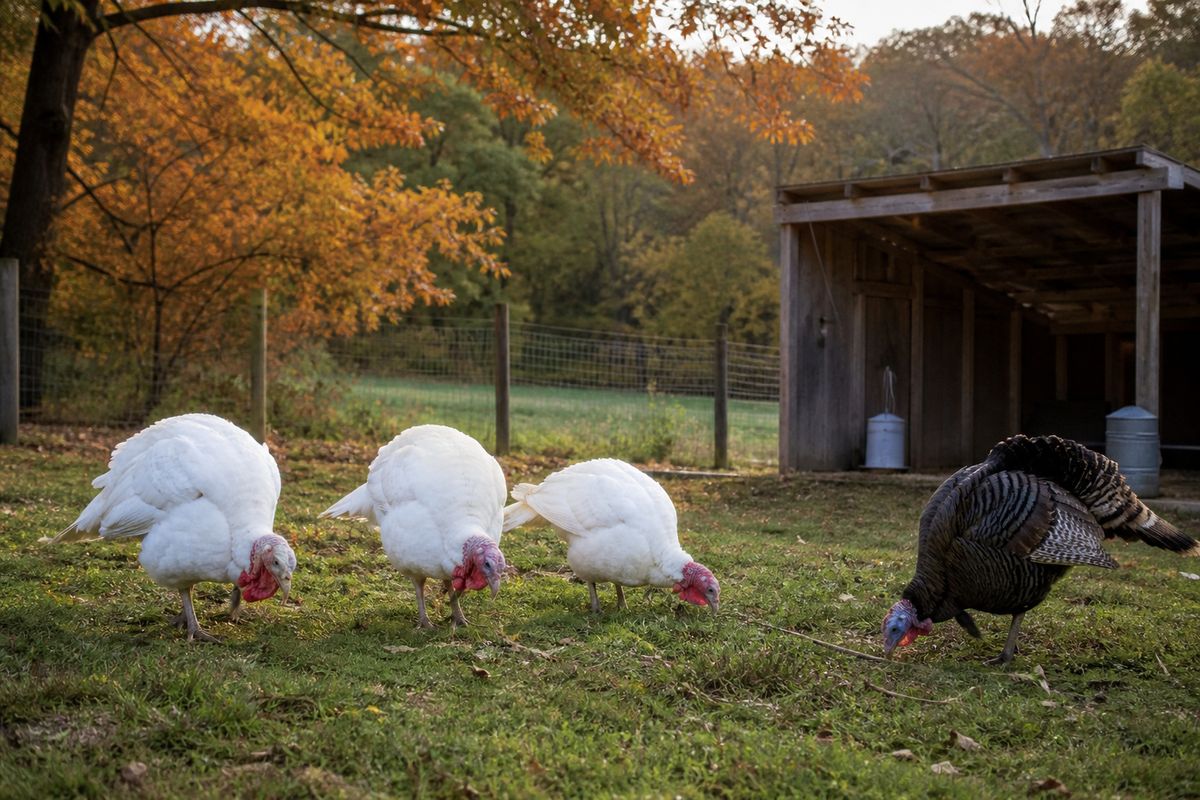
This guide picks up where Raising Backyard Turkeys leaves off — that guide covers breed choice and day-to-day care; this one is about hitting a specific date on the calendar and what happens on harvest day itself.
Working backward from the table
NCAT's ATTRA program (Pastured Turkey Production) gives real numbers that make the planning concrete:
| Type | Time to market | Live weight at 20 weeks |
|---|---|---|
| Broad Breasted White | About 12–14 weeks to marketable size; commonly processed at 14–18 weeks | Toms ~36 lb, hens ~24 lb |
| Heritage (Black, Bourbon Red, Narragansett, Slate, etc.) | Up to about 28–30 weeks | Toms ~23 lb, hens ~14 lb |
That's nearly double the grow-out time for a heritage bird versus a Broad Breasted White — which is exactly why ATTRA says holiday turkeys need their sign-up and poult purchase planned from late spring or early summer, not fall. Work backward from a late-November target: a heritage bird needs to start around late April or May to be ready; a Broad Breasted White has much more room and can often be started as late as midsummer for a 14–18-week grow-out. Order a few extra poults either way — ATTRA recommends planning for 15–25% mortality over the whole grow-out.
Feeding for the whole grow-out
ATTRA's feed program runs in three stages:
- Starter (0–8 weeks): 28% protein, crumbles for poults.
- Grow-out (8–16 weeks): 20% protein.
- Finisher (16 weeks to processing): at least 16% protein.
Budget for roughly 100 lb of feed per tom and 64 lb per hen over a full 20-week grow-out — buy more than you think you'll need. Offer grit free-choice in its own separate trough (not mixed into the feed), keep an eye on vitamin D specifically, and favor freshly cracked grain mash less than 30 days old, which ATTRA notes is meaningfully more nutritious than older stock.
The day before: feed withdrawal
ATTRA's turkey-specific guidance is 8–12 hours off feed, or up to 18–24 hours total when that window has to include transport and wait time at a processor. Pull water about two hours after feed is removed, not immediately — birds still need to hydrate during the withdrawal window. If you're hauling birds to a processor rather than handling them on-site, ATTRA recommends keeping the drive under three hours and avoiding transport in the rain. Catch and crate birds early, ideally before sunrise while they're still sleepy and easier to handle calmly.
Processing day basics
University of Minnesota Extension's home poultry processing guidance doesn't call out turkeys as their own scald category, but it gives two reference points: young birds scald at 125–130°F for 30–75 seconds, while older, larger birds scald closer to 140°F for the same time. Given a turkey's size and the age most home flocks process at, most people treat a mature bird like the "older bird" case rather than the "young bird" one — and a mature turkey often needs a pass with a torch or open flame afterward to singe off the hair-like feathers that plucking alone won't remove.
For evisceration, UMN Extension recommends the bar cut for a bird headed for roasting (rather than the smaller "J" cut), since a large bird gets trussed: cut a half-circle around the vent, free the vent, make a 3-inch side-to-side cut 1.5–2 inches below the keel point, and thread the intestine over that skin bar. Remove organs by hand, saving the gizzard, liver, and heart as giblets, then remove the lungs and gonads and wash the carcass inside and out.
Chilling: the 40°F rule
Pre-chill carcasses in cold tap water that's allowed to overflow slowly, then move to an ice-and-water bath to bring the carcass down to 40°F before packing it away. UMN Extension specifically notes that turkeys and other large birds need a few hours in that ice bath to get there — longer than a chicken. Hang the chilled carcass by a wing for about 10 minutes to drain before bagging it.
- Don't freeze until it's actually at 40°F or below.
- Freeze only a few unfrozen birds at a time in a home freezer — loading it up all at once slows freezing and risks partial thawing of what's already in there.
- Discard, don't taste-test, any bird with liver lumps or spots, measurable fluid in the body cavity, or other visible abnormalities.
Cooking it safely
Once it's thawed and ready for the oven, the target is the same as for any other poultry: see Safe Internal Temperatures for Homestead Meat & Poultry for exact numbers and where to actually place the thermometer in a whole bird. If you're canning extra meat or making stock from the carcass afterward, Canning Meat, Poultry & Broth Safely covers that step by step.
Track this year's flock from poult to table
The Turkey Flock Record Book gives you the breeding, feed, and processing log to put this guide's timeline into practice — order dates, feed stage changes, and weights all in one place. The Canning Inventory & Pantry Log picks up once the bird is in the freezer or the jar.
Browse the shop →More Chickens & Poultry guides
Free tool: Chicken coop size calculator →