Safe Internal Temperatures for Homestead Meat & Poultry: A Beginner's Guide
Color, juice clarity, and "it's been on long enough" are all unreliable. A calibrated thermometer and the right number for the right cut are the only things that actually tell you a chicken, a hog you raised yourself, or a rabbit off the hutch is safe to eat — and homestead meat carries a few risks a grocery-store cut doesn't.
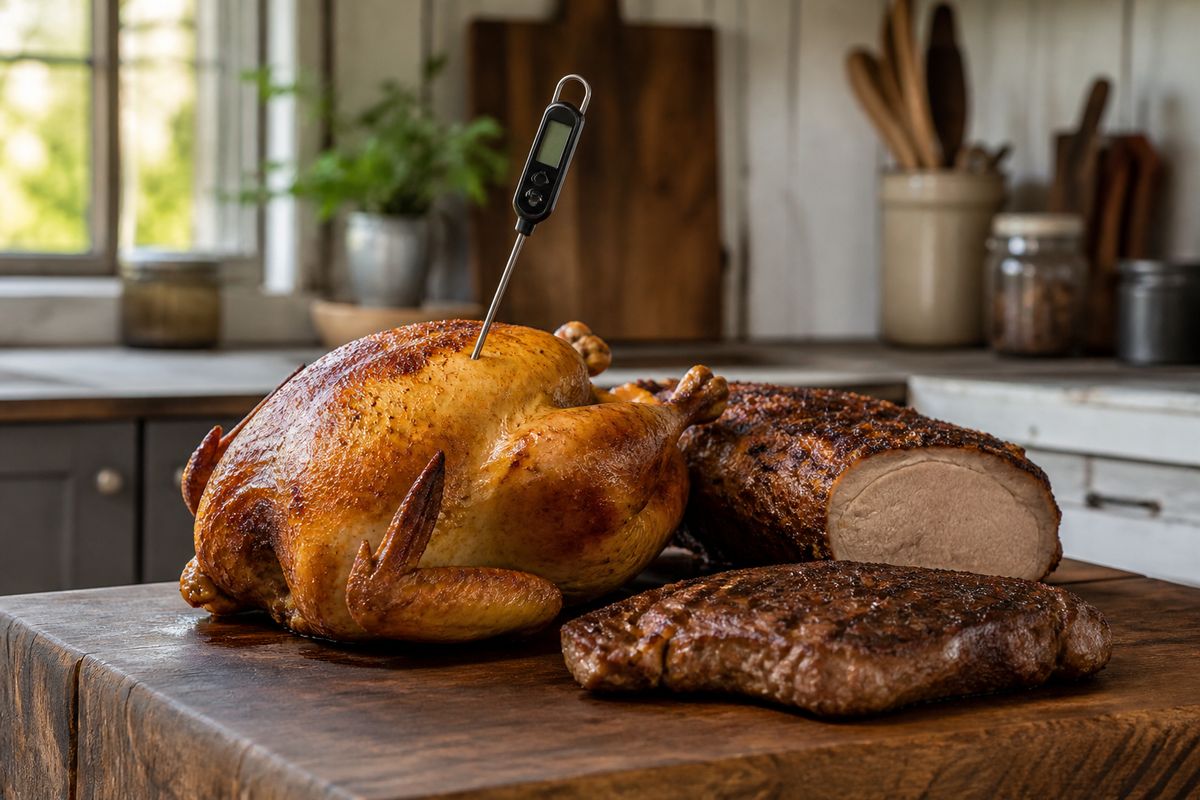
Why you can't judge doneness by looking at it
Pink color doesn't mean undercooked, and clear juices don't mean safe — both can mislead in either direction depending on the animal's age, diet, and how it was handled before cooking. The only method that actually confirms a safe internal temperature was reached is a food thermometer, read at the right spot, every time. This matters more for homestead-raised meat than store-bought: a backyard-processed broiler, a home-raised hog, or a rabbit off the hutch hasn't gone through the same inspection pipeline as a grocery-store cut, so the thermometer step isn't optional.
The chart: safe minimum internal temperatures
FoodSafety.gov's official Safe Minimum Internal Temperature Chart covers exactly the categories a homestead kitchen deals with most — including wild and farm-raised rabbit and venison, which most printed kitchen charts leave off entirely:
| Food | Internal temp | Rest time |
|---|---|---|
| Beef, bison, veal, goat, lamb — steaks, roasts, chops | 145°F | 3 minutes |
| Pork — steaks, roasts, chops | 145°F | 3 minutes |
| Ham, raw (fresh) | 145°F | 3 minutes |
| Ham, precooked (to reheat) | 165°F | — |
| Ground meat & sausage (beef, pork, lamb) | 160°F | — |
| Rabbit and venison (wild or farm-raised) | 160°F | — |
| Whole poultry, poultry parts, ground poultry | 165°F | — |
| Casseroles (meat, poultry, or meatless) | 165°F | — |
| Leftovers (any type) | 165°F | — |
| Eggs, raw — cooked for the plate | Until yolk & white are firm | — |
| Egg dishes (frittata, quiche) | 160°F | — |
| Seafood — fin fish | 145°F, or flesh separates easily with a fork | — |
| Shellfish — shrimp, lobster, crab, scallops | Flesh pearly and opaque | — |
| Clams, oysters, mussels | Until shells open | — |
Two things worth noticing: ground meat and ground poultry are hotter than their whole-muscle counterparts (160°F and 165°F vs. 145°F for a steak or chop) because grinding spreads any surface bacteria all the way through the meat. And rabbit and venison sit with ground meat at 160°F regardless of whether they're ground or whole — wild game in particular can carry a wider range of pathogens than farm-raised meat, so FoodSafety.gov doesn't give it the same 145°F break whole cuts of beef and pork get.
Where to actually put the thermometer
A correct number from the wrong spot isn't a correct reading. University of Tennessee Extension's thermometer guide gives placement by cut:
- Whole poultry: insert into the inner thigh area near the breast, not touching bone — bone conducts heat differently than meat and will give a false high reading.
- Ground meat patties and burgers: insert into the thickest area. For a thin patty, insert from the side so the tip actually reaches the center rather than passing through top to bottom.
- Roasts: insert into the center of the thickest part, away from fat, bone, and gristle.
- Thin cuts like steaks and chops: same center-of-thickest-part rule as roasts; for a very thin piece, insert from the side through to the center. On anything thick or irregular, check two or three spots — the coldest one is the one that counts.
Calibrate it, or the number means nothing
An uncalibrated thermometer can be confidently wrong by several degrees in either direction, which defeats the entire point of using one. University of Tennessee Extension gives two simple checks:
Boiling water method: bring clean water to a full rolling boil, insert the stem at least 2 inches for 30 seconds. It should read 212°F (altitude lowers this, so expect a slightly different number at elevation). Adjust if needed.
If it can't be calibrated: just correct for the known error when you read it — if it consistently reads 2°F high, cook chicken until it shows 167°F to actually reach 165°F.
Rest time isn't a formality
The 3-minute rest listed for whole-muscle beef, pork, lamb, veal, and fresh ham isn't just a serving suggestion — the temperature holds steady or keeps climbing during that time, which continues destroying any surviving pathogens on the surface. Cutting into the meat the moment it hits 145°F skips that extra margin.
The danger zone, and why "it was only out for a bit" isn't a safe call
University of Maryland Extension puts the danger zone at 41–140°F — the range where bacteria multiply fastest — and gives the rule plainly: never leave perishable food, raw or cooked, out of refrigeration for more than two hours, or more than one hour once the air temperature is above 90°F. That one-hour version matters on a homestead more than most places it gets quoted: field-dressing a deer on a warm afternoon, letting fresh-butchered poultry sit on a table while photos get taken, or leaving a cooler lid open during a long processing day can all burn through that hour without anyone noticing.
The short version
Use a calibrated thermometer, not your eyes. Put it in the thickest part of the cut, away from bone and fat, sideways for anything thin. Hit 145°F for whole-muscle beef/pork/lamb/goat and rest it 3 minutes, 160°F for anything ground (including rabbit and venison), and 165°F for poultry in any form. Keep raw and cooked meat out of the 41–140°F danger zone for more than 2 hours — or 1 hour above 90°F — and when in doubt about a reading, recheck a second spot before you decide it's done.
A printable version for the kitchen wall
This whole chart, plus placement and resting notes, fits on one printable page: the Meat Temperature Chart is sized for a kitchen or processing-room wall so you're never digging for a number mid-task. Raising and processing your own broilers start to finish? The Pastured Broiler SOP & Record Book Bundle includes a verification checklist that pairs with exactly this kind of safe-temperature check.
Browse the shop →