Preserving Fresh Eggs for Winter: A Beginner's Guide to Freezing, Water Glassing & What Not to Do
A healthy flock lays far more eggs than one household eats in spring and summer, then slows down hard once the days get short — see our guide to keeping hens laying through winter for the light/ventilation side of that. This is the other half: what to actually do with today's surplus so it's still good to eat in January. The honest answer disappoints a lot of homesteading folklore — one method works well, one traditional method isn't currently considered safe, and one "obvious" option doesn't work at all.
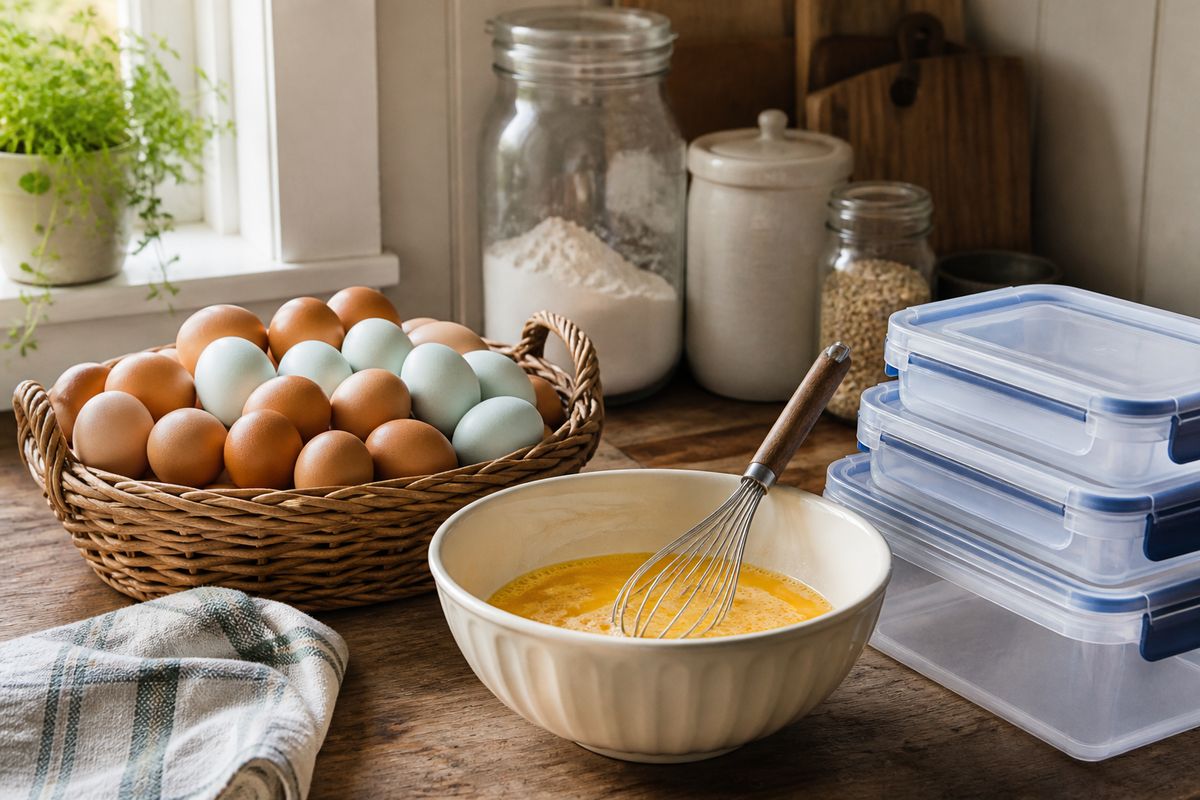
Why the fridge alone isn't a winter plan
Refrigerated at or below 40°F, unwashed and covered, a fresh egg keeps safely for at least a month, per Penn State Extension — store it in the carton with the pointed end down, on a shelf rather than the door, where temperature swings less. That's a real buffer, but it's weeks, not months, which is why a true surplus still needs an actual preservation method if it's meant to last through winter's slow-down.
Should you wash farm eggs before storing them?
Washing isn't required for eggs you're eating yourself, and Penn State Extension's guidance leans toward leaving them unwashed if you can. A fresh egg is coated in a natural seal called the cuticle, or "bloom," that closes the shell's thousands of microscopic pores against bacteria; washing, scrubbing, or rough handling removes it, and the bloom also weakens on its own over time regardless. If you do wash an egg, do it one at a time in water that's food-safe, at least 20°F warmer than the egg itself and never below 90°F, without scrubbing or submerging it, then rinse in slightly warmer sanitized water and dry before refrigerating. Never cold-dunk a batch of eggs to clean them — shell membranes are permeable enough that submerging, especially in cold water, can actually draw water (and whatever's in it) into the egg. Penn State calls this "a serious food safety concern no matter how clean the water is or the eggs are."
Freezing: the method that's actually recommended
Utah State University Extension's "Storing Eggs Safely" guide gives the specifics, and it's simpler than most people expect:
- Whole eggs: mix yolks and whites together gently, without whipping in air. For every cup of eggs, stir in 1½ tablespoons sugar or corn syrup (for sweet uses) or ½ teaspoon salt (for savory uses) to keep the texture from turning grainy and gluey after thawing. Strain, then freeze with ½ inch of headspace. Or skip the container: portion 3 tablespoons per compartment of an ice cube tray (3 tablespoons equals one egg), freeze solid, then bag the cubes for easy single-egg thawing later.
- Yolks only: same sugar/corn-syrup/salt ratio per cup, strained, with ½ inch headspace. One tablespoon of thawed yolk equals one egg yolk.
- Whites only: mix gently and strain — no sugar or salt needed. Two tablespoons equals one egg white, and whites freeze and thaw the most predictably of the three.
Water glassing: the traditional method, honestly assessed
Water glassing — submerging unwashed, uncracked eggs in a lime or sodium silicate solution to seal the shell for months at room temperature — shows up constantly in homesteading folklore as a cheap, no-power alternative to freezing. It's a real historical practice, but it's worth being straight about where extension guidance actually stands on it today: both Utah State University Extension and Penn State Extension describe it as not considered safe for modern use, for three compounding reasons rather than one. It requires unwashed eggs, which are more likely to come from a small flock with a higher background rate of Salmonella than commercially inspected eggs. The solution can seep through the shell over time. And a cool pantry or basement — the whole point of a method that needs no refrigeration — rarely holds a steady 40°F or below the way a modern recipe would assume; temperature swings in that range are exactly what let Salmonella Enteritidis grow. Neither source gives a tested storage duration for the method, which is itself a signal: there's no current research backing a specific "it's good for X months" claim the way there is for freezing.
What about a home dehydrator, or freeze-drying?
Simpler answer: a standard home food dehydrator can't get eggs dry enough to be shelf-stable — it doesn't reach the temperature or do the processing a safe dried-egg product actually needs, per Utah State University Extension. If you're using a dedicated home freeze-dryer, the same caution applies as freezing: the process doesn't sterilize raw eggs. Label freeze-dried raw egg clearly, keep it away from other food to avoid cross-contamination, and rehydrate and cook it to a proper internal temperature before eating — never treat it as ready-to-eat on its own.
A note on pickled eggs
Pickled eggs are popular and genuinely tasty, but Penn State Extension is explicit that there's no approved home-canning recipe for them — they have to stay refrigerated, be made in sterilized jars, and be eaten within three to four months. Leaving pickled eggs at room temperature, the way an actual canned product could sit on a shelf, is a real botulism risk, not a theoretical one; the acid and salt in a pickling brine aren't enough on their own to make an uncanned, unrefrigerated jar of eggs safe.
The short version
A healthy laying flock's surplus is a real preservation problem, not just a fridge-management one. Freezing (cracked out of the shell, with sugar or salt stirred in to protect the texture) is the method with actual tested guidance behind it. Water glassing is a real tradition but isn't currently considered safe by the extension services that have looked at it, mainly because it depends on conditions — a steady sub-40°F room, and unwashed eggs with low bacterial risk to begin with — that most kitchens and flocks can't reliably guarantee. Skip the dehydrator for raw eggs entirely, and if you pickle any, keep the jar in the fridge and eat it within a few months.
Track the flock that's giving you this problem in the first place
A real surplus is a good sign — the Chicken Flock Record Book tracks daily egg counts by hen so you actually know how much you're putting up each week, not just guessing from a full egg basket. Once a batch is frozen and labeled, the Canning Inventory / Pantry & Freezer Log keeps track of what's in the freezer and how long it's been there, right alongside your canned goods.
Browse the shop →More Chickens & Poultry guides
Free tool: Chicken coop size calculator →