Growing Cucumbers in a Backyard Garden: A Beginner's Guide to Trellising, Pollination & Bitterness
Most beginner cucumber problems trace back to one of three things: not enough room for the vine, not enough bees visiting each flower, or heat stress making the fruit bitter. Get those three right and a couple of plants will keep a kitchen supplied all summer.
For how cucumbers fit into a wider vegetable bed — and which neighbors actually help or hurt them — see our companion planting guide.
Spacing: the one decision that shapes everything else
Cucumbers can be grown three ways, and the right spacing depends on which one you pick. The University of Maryland Extension and Iowa State University Extension's Yard and Garden program give consistent numbers across all three:
- Hills: sow 4 to 5 seeds per hill, thin to 2 or 3 plants once seedlings have their first true leaves. Space hills 3 to 5 feet apart in both directions (bush varieties can go as close as 3 feet).
- Rows: sow seeds about 6 inches apart and thin to 15 to 18 inches, with 4 to 6 feet between rows.
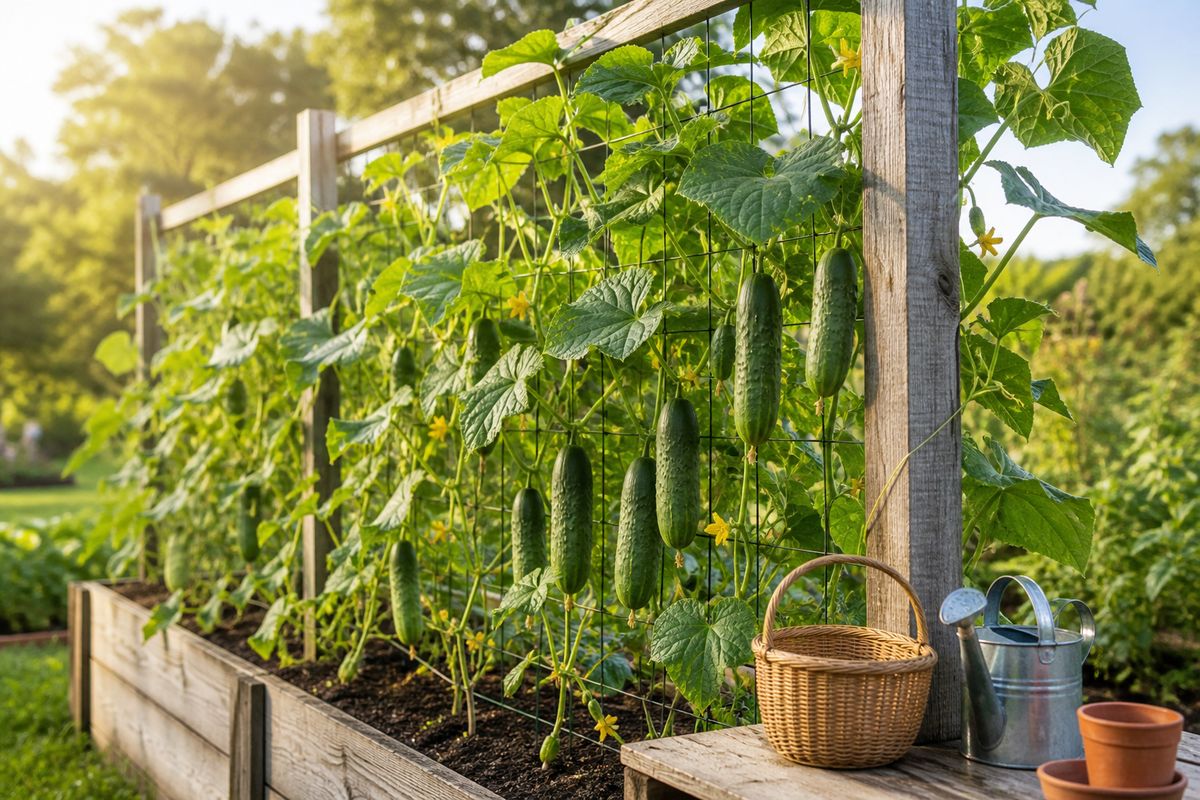
- Trellised: sow 4 to 5 seeds per foot along the trellis line, then thin to 9 to 12 inches apart once plants are 4 to 5 inches tall.
Trellising is worth the extra setup for a small yard: it saves ground space, lifts fruit off the soil (fewer slug and rot problems), and makes the crooked, hook-shaped fruit that forms when a cucumber rests against something far less common. Plant 1 inch deep, after frost danger has passed and the soil has warmed — Iowa State times this to roughly mid-May in central latitudes, a week earlier in the south of a given zone and a week later in the north, with July 10 as a reasonable last practical sowing date for a second crop almost anywhere.
Pollination: why some flowers never become cucumbers
Cucumbers are monoecious — one plant produces separate male and female flowers rather than a single perfect flower. Iowa State describes the sequence plainly: the first flowers to open are male, and female flowers (recognizable by the small immature fruit already sitting at the base of the bloom) follow after. Bees have to physically carry pollen from a male flower to a female one for fruit to form at all, and University of Maryland Extension puts a real number on how much work that takes: a flower typically needs 8 to 12 separate bee visits to set a full, straight fruit. Fewer visits than that, and you get a shriveled or lopsided cucumber instead of a straight one.
Seed catalogs also sell two variants worth knowing about before you buy: gynoecious varieties produce almost all female flowers and fruit earlier with a heavier, more concentrated set (the seed packet includes a small percentage of standard seed mixed in to supply pollen), and parthenocarpic varieties set seedless fruit without pollination at all — useful under row cover or in a greenhouse, but they'll cross-pollinate and develop seeds if grown near a standard variety, and the seed itself costs more.
Why cucumbers turn bitter — and how to stop it
Bitterness isn't random: Iowa State traces it to specific compounds, cucurbitacin B and C, that are normally concentrated in the leaves, stems, and roots and move into the fruit when the plant is under stress. In practice, the trigger is almost always the same thing: hot, dry weather. A cucumber plant that goes without consistent water during a heat spell is the classic bitter-fruit scenario, and the fix is equally direct — water deeply about once a week, more often during dry stretches, so the plant is never stressed long enough to push those compounds into the fruit.
Bitterness concentrates at the stem end and just under the skin, so a mildly bitter cucumber can often be salvaged by cutting off an inch at the stem end and peeling it. If bitter fruit is a recurring problem in your garden regardless of watering, Iowa State names three varieties bred to be less prone to it: Sweet Slice, Sweet Success, and Marketmore 76.
Cucumber beetles: the pest that actually matters
Striped cucumber beetles are the pest both extension offices flag as the real threat — not just for the feeding damage adult beetles and larvae do, but because adults spread bacterial wilt, a disease that can kill a healthy-looking vine within days once it takes hold. Floating row cover over young seedlings is the standard defense (removed at flowering, per the pollination note above), and Iowa State offers a timing trick worth knowing: cucumber plantings made after mid-June tend to suffer noticeably less beetle damage than an early-spring planting, since they miss the first beetle generation's peak activity. If you do need an insecticide, choose one labeled low-toxicity to bees and apply it in early morning or late evening, when bees are least active.
Choosing a disease-resistant variety is the other half of the defense — Cornell maintains a list of cucumber varieties bred for resistance to bacterial wilt and powdery mildew, worth checking before you buy seed if either has been a problem in your garden before.
Harvest and storage
Cucumbers grow fast enough that a twice-weekly check isn't enough — both extension offices recommend harvesting every 2 to 3 days once fruit sets, since a cucumber left on the vine too long slows the plant's production of new fruit elsewhere.
| Type | Harvest size |
|---|---|
| Pickling cucumbers | 2 to 4 inches long |
| Slicing cucumbers | 5 to 8 inches long, 1½ to 2 inches in diameter, still dark green and firm |
Twist the fruit parallel to the vine with a quick snap, or cut it, rather than pulling straight out, which can damage the vine and reduce the rest of the season's set. Harvest after any morning dew has dried off the leaves — picking while foliage is wet is one of the easier ways to spread disease through a planting by hand. For storage, cucumbers hold 10 to 14 days at 50 to 55°F and 90 to 95% relative humidity; a standard home refrigerator runs colder than that and will shorten storage life and texture over time.
The short version
Give the vine room to spread or climb, leave the bees alone to do their job during bloom, keep the soil consistently moist through hot spells so the fruit doesn't turn bitter, and pick every 2 to 3 days once the vines get going. The cucumber beetle is the one pest worth actually planning around — row cover until bloom, then watch for bacterial wilt.
Keep these numbers where you'll actually use them
This article covers the reasoning; the Growing Cucumbers Quick-Grow Guide puts the spacing, pollination, and bitterness-prevention steps on a short printable reference for the garden. If you're planning a whole vegetable bed around it, the Homestead Garden Master Planner covers companion planting, pest identification, and bed layout in one system, and our guides to tomatoes and peppers cover the rest of a typical summer bed.
Browse the shop →