Backyard Composting for Beginners: Turn Scraps Into Rich Garden Soil
A compost pile that just sits there cold, or one that smells like rotten eggs, isn't broken — it's almost always one of the same handful of fixable problems. University extension research narrows it down to size, moisture, and the ratio of two kinds of material.
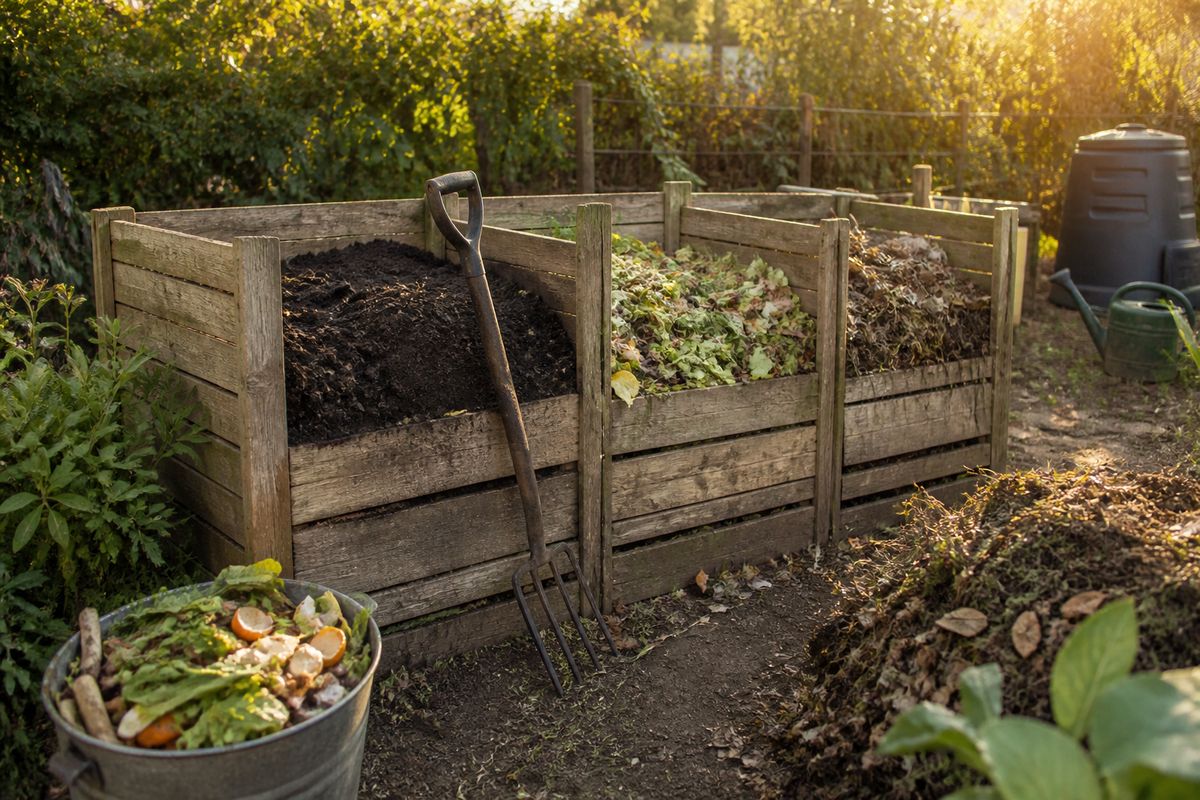
Composting is just managed decomposition: give microbes the right mix of carbon, nitrogen, air, and moisture, and they turn kitchen and yard waste into finished compost in weeks rather than the year or more it takes a neglected pile. Getting that mix right is simpler than it sounds once you know the actual numbers.
Greens, browns, and the ratio that actually matters
Every recipe for a working compost pile comes down to balancing two material groups:
- "Browns" (carbon): dry leaves, straw, shredded paper and cardboard, wood chips, twigs, and nut shells. These feed microbes energy but break down slowly on their own.
- "Greens" (nitrogen): grass clippings, fresh plant trimmings, fruit and vegetable scraps, coffee grounds, and livestock manure. These supply the protein microbes need to multiply fast.
Washington State University Extension puts the ideal carbon-to-nitrogen ratio for active, hot composting at roughly 30 parts carbon to 1 part nitrogen — in practice, a pile built mostly of browns with a solid layer of greens mixed through, not a 50/50 split by volume, since browns are so much less nitrogen-dense.
Building a pile that actually heats up
Oregon State University Extension gives two numbers that matter more than most beginners expect:
- Size: at least 0.5 to 1 cubic yard of fresh material during the growing season — roughly a cube a little over 2.5 feet on each side. Smaller piles rarely hold enough heat to get hot composting going at all; if yours won't heat, the fix is usually more volume, not more turning.
- Moisture: about 60–65% — damp like a wrung-out sponge, not dripping and not dry and dusty.
Built correctly, a pile should heat up within about a week. OSU targets 130–135°F to kill weed seeds and pathogens; WSU notes hot piles can run as high as 160°F at their peak, through nothing more than microbial activity.
Turning and finishing
OSU recommends leaving a new pile alone for the first three to five weeks, then turning it with a garden fork to add oxygen and break up any clumped material — turning too early just slows the initial heat-up. WSU Extension draws a useful distinction between two approaches: active (hot) composting finishes in weeks by running hot enough to sanitize the material, while passive (cold) composting sits at outdoor temperatures and takes much longer, but preserves more of the heat-sensitive beneficial microbes some gardeners prefer for finished compost.
What to leave out
A few materials cause most backyard composting complaints:
- Meat, fish, fat, oil, dairy, bread, and bones — OSU flags these as the main things that draw rodents and other wildlife to a pile. Skip them if pests are a concern.
- Dog and cat manure — the Cornell Waste Management Institute specifically warns these can carry pathogens that survive home composting; leave them out entirely.
- Wood chips, nut shells, twigs, and eggshells are fine to add but break down much more slowly than the rest of the pile — expect them to still be recognizable when everything else is finished.
Troubleshooting a problem pile
| Problem | Likely cause | Fix |
|---|---|---|
| Pile won't heat up | Too small, or too dry | Build up to at least 0.5–1 cubic yard; moisten to sponge-damp |
| Rotten-egg smell | Too wet and not enough air (low oxygen) | Mix in dry browns like straw or shredded paper, turn it, and cover from rain |
| Rodents or wildlife visiting | Meat, dairy, or exposed fresh scraps | Remove meat/dairy, bury fresh scraps in the pile's center, line the bin with hardware cloth |
Do you need a fancy bin?
No — a simple wire cylinder, a pallet bin, or even a freestanding pile all work, as long as the pile itself is sized and balanced correctly. Where a structured bin earns its keep is in separating the pile into stages: fresh material going in, an actively cooking middle stage, and a finished stage ready to use — which is exactly what a three-bin system is built around, and it removes the guesswork of "is this done yet?" that trips up a lot of single-pile setups.
Build a system that actually finishes compost
A dedicated three-bin setup solves the "fresh vs. finished" mixing problem structurally instead of by guesswork. The Homestead Three-Bin Compost System Guide walks through the full build, and the Homestead Garden Master Planner helps you put that finished compost to work with a season-by-season bed and soil plan.
Browse the shop →