Growing Tomatoes in a Backyard Garden: A Beginner's Guide to Spacing, Staking & Blossom End Rot
Tomatoes are the single most-planted backyard crop in the country, and also the one most beginners get wrong in the same three places: too little support, inconsistent watering, and a fertilizing schedule that either stops too early or never starts.
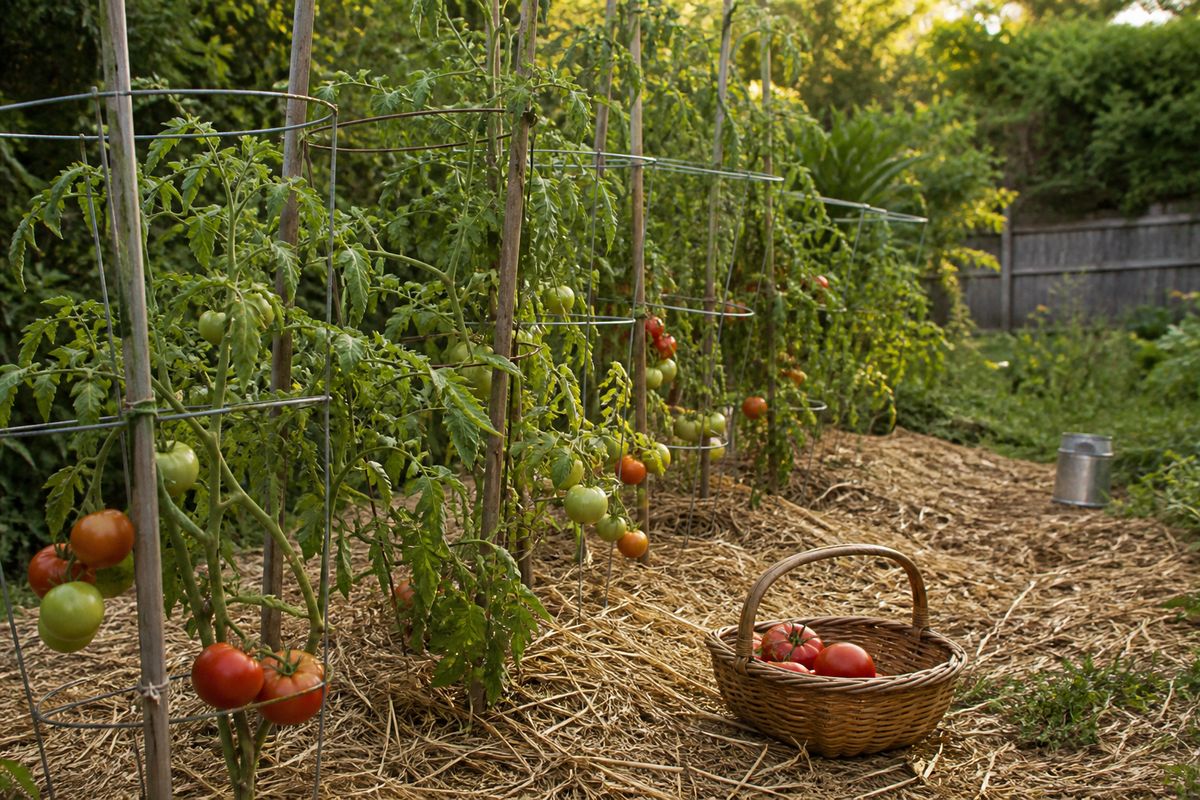
Nothing about growing a good tomato crop is complicated, but a surprising amount of it is counter-intuitive the first time through — burying the stem deeper than feels right, feeding on a schedule rather than once at planting, and the fact that blossom end rot usually isn't actually a soil calcium problem. Here's what university extension research actually recommends, start to harvest.
Determinate or indeterminate — it changes how you stake and when you harvest
University of Wisconsin–Madison Extension draws the key distinction every beginner should know before buying transplants: determinate varieties set a flower cluster at the top growing point and then stop gaining height — they tend to ripen a large share of their fruit in a shorter window, which suits canning. Indeterminate varieties set flower clusters along the sides of an ever-lengthening vine and keep growing and producing until frost, which suits a steady trickle of fresh eating all season. Determinate plants generally need less aggressive staking since they stop growing taller; indeterminate vines will keep needing more support as the season goes on.
Site, spacing, and planting depth
University of Georgia Extension's guidance for a strong start:
- Sun: 6–8 hours of direct sunlight a day — less than full sun means less fruit.
- Soil pH: 6.2–6.8.
- Planting depth: bury the transplant deep, down to the first set of true leaves. This feels wrong the first time, but tomato stems root readily along their buried length, building a stronger root system than planting at the original soil line would.
- Spacing: about 2 feet between plants within a row, with 4–6 feet between rows.
- Firm the soil around the transplant after planting to remove air pockets that can dry out young roots.
Staking, caging, and trellising
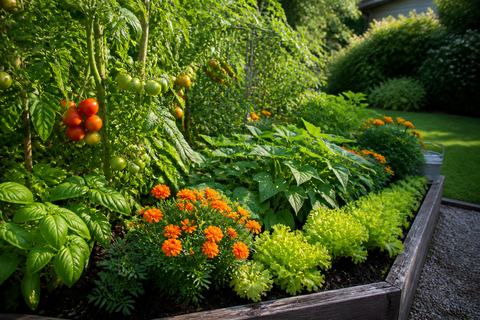
Tomatoes can sprawl on bare ground, but University of Wisconsin–Madison Extension is direct about the tradeoff: sprawling plants use more garden space and see more leaf and fruit disease from soil contact and poor airflow. Nearly every garden tomato benefits from real support — the main choices:
- Cages (purchased wire cages or towers) give the highest yield per square foot of garden space for the least ongoing labor, and are reusable season to season.
- Staking works well too: University of Georgia Extension describes driving a wooden stake 5–6 feet long about a foot deep between every other plant, then weaving twine or strips of cloth around the stakes in rising rows as the plants grow taller.
- Trellising suits indeterminate vines grown in a single row against a fence or frame.
Watering and mulching
Extension sources agree on roughly 1 to 2 inches of water a week for the whole season (University of Georgia puts it at 1–2 in./week from rain plus irrigation combined; Mississippi State Extension's figure is 1–1.5 in./week). The more important detail than the exact number is consistency: give the bed one or two deep, thorough soakings rather than frequent light sprinkles, and water the soil directly rather than the foliage — wet leaves are what invite fungal disease. A layer of mulch (straw works well) keeps soil moisture and temperature more even between waterings, keeps ripening fruit cleaner off the ground, and suppresses weeds, per University of Wisconsin–Madison Extension.
A fertilizing schedule that actually works
University of Georgia Extension gives a concrete, repeatable schedule rather than a one-time feeding:
| Timing | Application |
|---|---|
| Before planting | 1.5 lb of 10-10-10 fertilizer per 100 sq ft, worked into the bed |
| At transplanting | 2 tbsp of 5-10-10 fertilizer worked in around each plant |
| When fruit is quarter-sized | 1 lb of 10-10-10 per 100 sq ft |
| Every 3–4 weeks after | Repeat the quarter-sized-fruit application until harvest ends |
Blossom end rot: the calcium myth
The fix is almost always watering consistency, not a calcium supplement: maintain even soil moisture with regular deep watering and a layer of mulch, and keep soil pH in the 6.2–6.8 range so calcium that is present stays available to the plant. Mississippi State Extension's guidance agrees that inconsistent watering is a primary driver alongside calcium deficiency. Foliar calcium sprays are, at best, a short-term patch — they don't fix the underlying watering-consistency problem that caused the rot in the first place.
Pests and diseases to watch for
- Soft-bodied insects (aphids and similar) respond well to insecticidal soap; caterpillar pests respond to Bt (Bacillus thuringiensis) — University of Georgia Extension recommends scouting plants regularly, since any pest is easier to control while numbers are still low.
- Fusarium and verticillium wilt are soil-dwelling fungal diseases, per University of Wisconsin–Madison Extension, that get worse the longer tomatoes are grown in the same spot year after year. Two real defenses: choose resistant cultivars (look for a "V" and/or "F" on the variety tag or in the seed catalog description) and rotate where you plant tomatoes from year to year rather than using the same bed every season.
From this season's crop to a full growing system
For a focused, no-fluff walkthrough of exactly this — spacing, staking, feeding, and troubleshooting in one place — the Growing Tomatoes Quick-Grow Guide is built for exactly this crop. Want the deeper version with recipes for turning a real harvest into sauce, salsa, and more? The Homestead Tomato Garden covers the full season start to preserved pantry.
Browse the shop →