
Heating a Hunting Cabin Safely: A Beginner's Guide to Carbon Monoxide, Insulation & Condensation
A hunting blind is drafty on purpose, which is exactly why a propane heater inside one rarely causes a carbon monoxide problem — the real danger there is the heater tipping over. An insulated cabin built for an overnight stay is a different structure with a different risk: seal it up tight enough to actually hold heat, and you've also sealed in whatever a heater burning inside it produces.
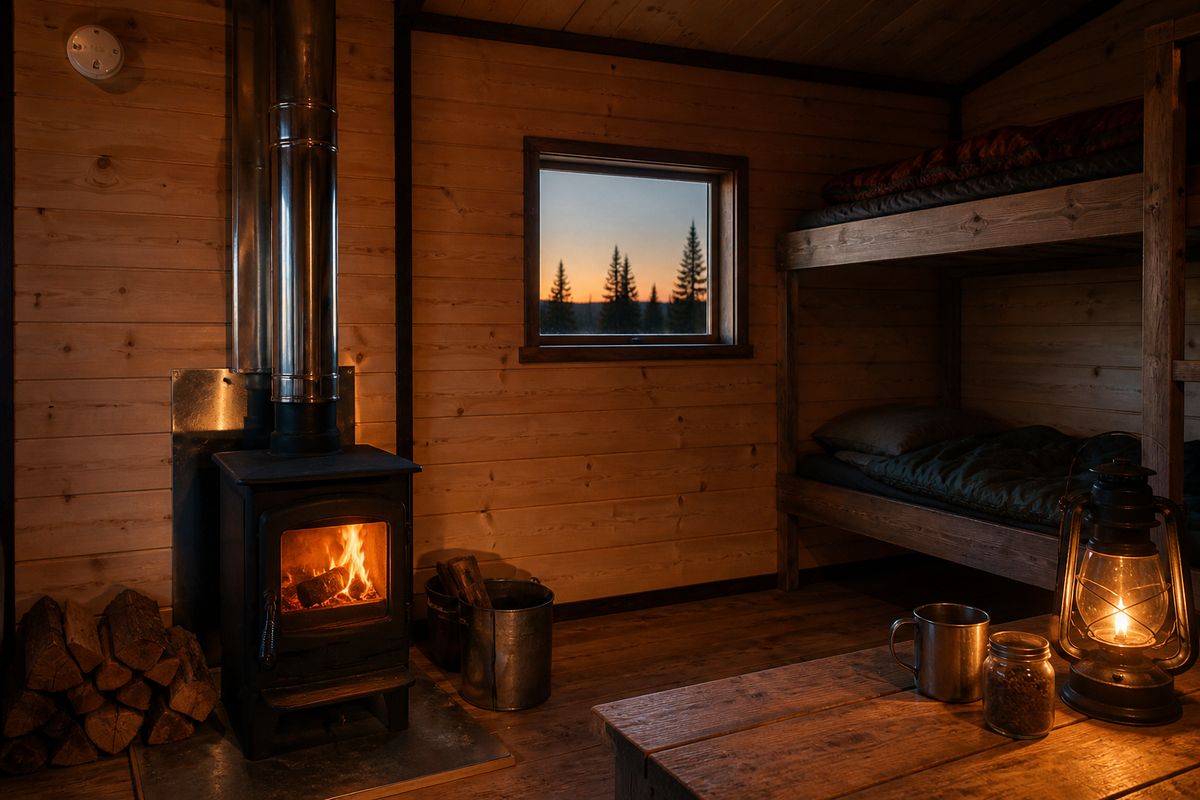
This guide covers the part that's easy to skip when the exciting work is cutting lumber and framing walls: what to burn, how to vent it, and how to insulate the space without turning it into either a damp box or a sealed one.
Why a sleeping cabin is a different risk than a blind
University of Arkansas Division of Agriculture Cooperative Extension draws this distinction directly for hunters: blinds are drafty, so carbon monoxide (CO) buildup there is typically not a problem — the main concern with a heater in a blind is fire risk if it tips over. Enclosed spaces such as cabins and campers pose a greater CO risk, and that risk is exactly why an overnight hunting cabin needs its own set of rules that a day blind doesn't. Forced-air heaters make this worse: they're only appropriate in very well-ventilated areas and are poorly suited — and dangerous — in anything built to hold heat in.
The scale of the risk, and why you can't smell it coming
CO is colorless and odorless — there is no way to detect a buildup by smell or sight, which is exactly why detection has to be mechanical rather than human. The CDC estimates at least 420 people die from CO poisoning in the U.S. each year, with more than 100,000 emergency room visits. Minnesota's Department of Public Safety puts a more specific number on one enclosed-shelter category alone: CO kills one to two people a year in that state's ice fishing houses, almost always because a heat source wasn't properly vented. A CO level is generally considered dangerous starting around 70 parts per million — the threshold at which a standard home-style CO alarm sounds.
| Exposure level | What it feels like |
|---|---|
| Low | Tiredness in otherwise healthy people; chest pain if you have heart disease |
| Medium | Flu-like symptoms — nausea, dizziness, headache, confusion; impaired vision and coordination; breathing difficulty; a reddish skin tone |
| High | Convulsions or seizures, loss of consciousness, death |
Notice how much the medium-level symptoms overlap with simply feeling tired or getting a headache after a long day in the cold — which is precisely how people talk themselves out of taking it seriously until it's too late.
The heater mistakes that actually cause this
- Using a heater rated for outdoor use only, indoors. Heaters built for outdoor use lack the safety features — oxygen-depletion sensors, anti-tipping shutoffs — that an indoor-rated unit has. Check the rating before it ever goes inside the cabin.
- Running a forced-air heater in a sealed space. These are only appropriate in very well-ventilated areas; a small insulated cabin built to hold heat is the opposite of that.
- Trusting an old anti-tip sensor without testing it. Newer heater models shut off automatically if tipped over or moved too fast. Test yours at home, with fresh eyes on the result, before it goes into the field — not for the first time on a cold night in the woods.
- Skipping the filter and feature check. Inspect heater filters and confirm every safety feature actually works before the trip, every trip, not just the first one.
- Heating with a cook stove. A propane stove left running for heat, as in the Sharp County case above, is not a heater and doesn't have a heater's safety features.
Non-negotiables for every overnight stay
- Bring a battery-operated CO alarm with fresh batteries, every trip. This is the single most-repeated piece of advice across every extension and public-safety source on this topic, for a reason: it's the only thing that detects CO before a person does.
- Crack a window or vent for airflow whenever a heater is running, even in a well-insulated structure. A sealed room and a combustion appliance are a bad combination no matter how cold it is outside.
- Walk through and check vents periodically if the cabin has any built-in heating system, to confirm nothing — snow, ice, debris — is blocking them.
- Treat headache, nausea, or dizziness in the cabin as a reason to get outside immediately, not as a sign you're just tired from the day.
Insulating for warmth without sealing out the air you need
The same qualities that make a cabin warm — a tight building envelope, good insulation, few drafts — are exactly what lets CO concentrate if something goes wrong with how it's heated. Insulating well and ventilating deliberately aren't in conflict; they're both necessary, and skipping the second to get more of the first is where the risk above actually comes from.
| Insulation type | R-value per inch |
|---|---|
| Fiberglass, loose-fill | 2.2 |
| Fiberglass, batts or rolls | 3.2 |
| Mineral wool | 3.1 |
| Cellulose fiber, loose-fill | 3.7 |
| Expanded polystyrene board | 4.0–4.5 |
| Extruded polystyrene board | 5.0–5.5 |
| Polyurethane board or spray | 6.0–7.5 |
University of Missouri Extension's figures (written for houses, not cabins, but the physics don't change) give a sense of scale: a standard 3.5-inch fiberglass batt in a stud wall provides roughly R-11. That's a reasonable, affordable starting point for a small sleeping structure, though check whatever local building code applies to your project before deciding what's enough for your climate.
Fiberglass and mineral wool batts are themselves nonflammable, but their paper or foil facing is not — cover any exposed facing with a fire-resistant material like half-inch drywall or equivalent paneling rather than leaving it bare, the same rule that applies inside a house.
The overnight checklist
- CO alarm packed, batteries fresh, tested before you leave home
- Heater confirmed rated for indoor/enclosed use — not outdoor-only
- Anti-tip sensor tested at home, not for the first time in the field
- Window or vent cracked whenever the heater runs
- Propane connections checked for leaks (a soap-and-water bubble test on fittings works well) before each use
- No cook stove ever used as a space heater
- Anyone feeling tired, headachy, or nauseous inside the cabin goes outside first, asks questions second
Build the cabin, then heat it right
The Hunting Cabin Plans guide walks through building the insulated sleeping structure this article is written for — posts, platform, walls, roof, and the insulate-and-line stage specifically. If you're hunting from a day blind instead of overnighting, the drafty-structure math above is why the Hunting Blind Plans guide's safety chapter focuses on fall protection rather than CO.
Browse the shop →For the ladder, harness, and site-selection side of a hunting structure — not covered here — see Building a Hunting Blind. Wood heat at home carries its own, related CO risk through a blocked flue or closed damper — see Firewood & Wood Heat for the Homestead. And if you're building out a broader cold-weather and power-outage plan, the family emergency binder guide covers CO alarms and generator placement at home.
More Building & Off-Grid Living guides


- Sources:
- University of Arkansas Division of Agriculture Cooperative Extension — Be Aware of Carbon Monoxide Dangers Both in the Home and on the Hunt
- Minnesota Department of Public Safety — Preventable Tragedy: CO Poisoning in Ice Houses
- University of Missouri Extension — Insulating and Weatherizing Your Home (EM0104)