Firewood & Wood Heat for the Homestead: Seasoning, Stacking & Chimney Safety
Wood heat is cheap, reliable in a power outage, and forgiving of beginner mistakes right up until it isn't. Most of what goes wrong with a wood stove or fireplace traces back to one of three things: wood that wasn't actually dry enough to burn clean, a chimney nobody checked, or carbon monoxide that nobody was watching for.
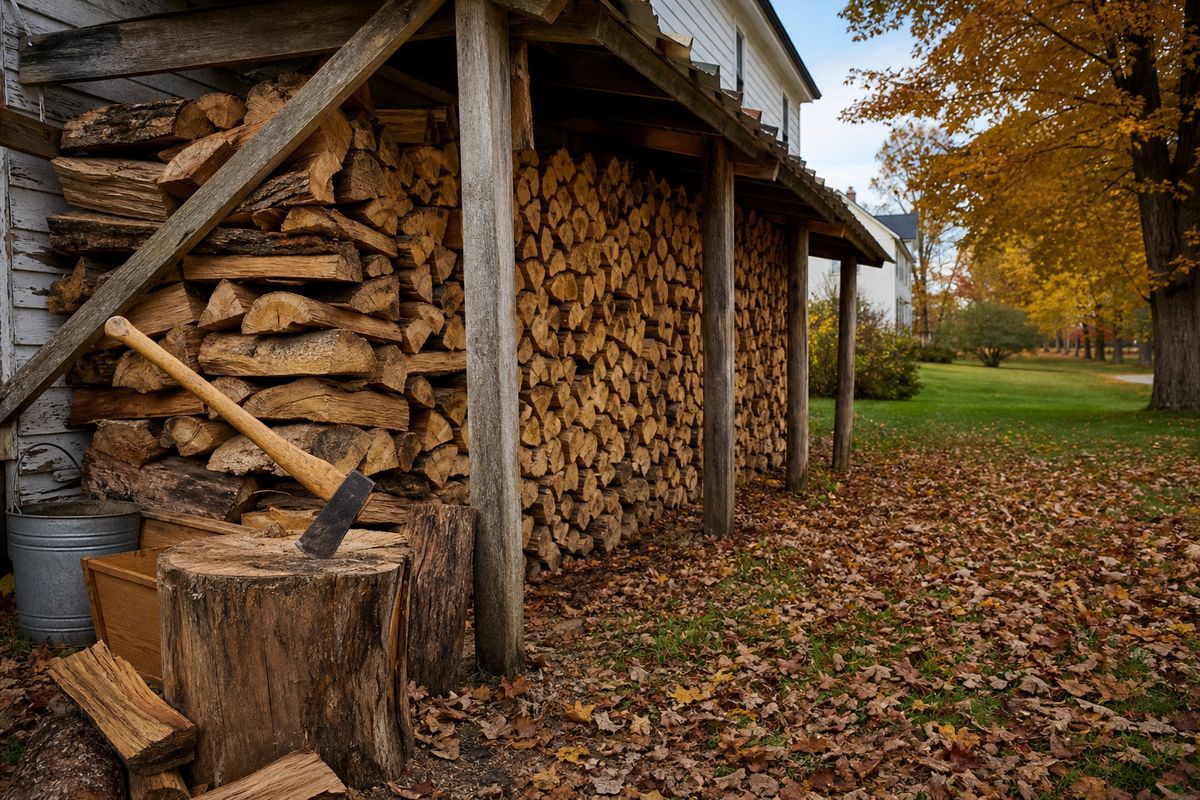
If a winter storm knocks out the power, a working wood stove or fireplace can be the thing that keeps a homestead's water pipes, animals, and people through it — the winterizing checklist and the family emergency binder both assume some form of backup heat exists. This guide covers the part neither of those gets into: getting the wood itself right, and running the appliance that burns it safely.
How much wood you actually need
There's no single number — it depends on the appliance, the species, and how many hours a day it runs. University of Idaho Extension's rule-of-thumb figures give a useful range: a traditional, lower-efficiency fireplace used three to four nights a week over a winter typically burns around 2 cords, while a fire kept going all day, every day can use up to 10 cords. A modern, efficient slow-combustion wood stove can cut either of those figures by more than half compared to an open fireplace.
Species matters more than most beginners expect — a cord of one wood can carry nearly twice the useable heat of another:
| Species | Heat value (million BTU per cord) |
|---|---|
| Osage orange | 30.7 |
| Shagbark hickory | 28.6 |
| Black locust | 28.1 |
| White / bur oak | 26.5 |
| Red / black oak | 24.4 |
| Hard maple | 23.7 |
| Green ash | 23.0 |
| Black walnut | 22.3 |
| Sycamore | 20.7 |
| Silver maple | 19.5 |
| Cottonwood | 16.1 |
A homestead with its own woodlot can plan around whatever grows there; a homestead buying firewood should buy only neatly stacked cords (or clearly measured fractions of one) — never a "truckload," which has no standard volume at all.
Seasoning: the one number that decides if wood is actually ready
"Seasoned" firewood isn't about how long it's been sitting around — it's about moisture content. Extension sources put the usable target at below 20–25% moisture, and fresh-cut ("green") wood usually needs a full six to nine months split and drying outdoors to get there, not weeks.
You don't need a moisture meter to get a reasonable read on a piece of wood:
- Look at the end grain. Small radial splits/cracks at the cut ends are a sign the wood has dried and shrunk.
- Listen. Knock two pieces together — dry wood gives a sharp, clinking sound; green wood sounds duller and heavier.
- Lift it. Seasoned wood is noticeably lighter than the same piece would have been when freshly cut, since it's lost most of its water weight.
Burning wood before it's actually seasoned doesn't just waste it — green wood produces more smoke and less heat, and (see below) it's the single biggest driver of the chimney buildup that causes chimney fires.
Stacking for airflow, not just storage
How wood is stacked affects how fast it seasons and how well it stays dry once it is:
- Off the ground. Stack on pallets, rails, or a raised rack — wood sitting directly on soil wicks up moisture and seasons far more slowly, if at all.
- Covered on top, open on the sides. If you tarp a stack, cover only the top and leave the lower ends of the rows open so air can still move through — fully wrapping a stack traps moisture inside it instead of letting it escape.
- Split before stacking. Splitting exposes far more surface area to air than a round, bark-covered log, which is most of why split wood seasons in months rather than years.
Creosote and chimney fires
Most chimney fires trace back to one cause: creosote, a tar-like residue that condenses out of wood smoke onto the inside of a flue. It's highly flammable, and once enough builds up it can ignite inside the chimney itself. Three things reliably make creosote worse: burning unseasoned (wet) wood, running a fire cool and smoldering instead of hot and clean-burning, and going too long between inspections.
Burning only well-seasoned hardwood and keeping fires burning hot rather than banked down low are the two single biggest things a homeowner controls day to day to keep creosote from building up between those annual cleanings.
Carbon monoxide: the risk wood heat shares with generators
Most people associate carbon monoxide danger with generators, but any wood-burning appliance produces CO too, and a blocked flue, closed damper, or poor draft can send it indoors instead of up the chimney. CO is colorless and odorless — there's no way to detect a leak by smell, which is exactly why detection has to be mechanical, not human.
- Install a CO alarm on every habitable level of a home with a chimney, wood stove, or fireplace, and within about 10 feet of every bedroom door.
- Replace CO alarms every 5–7 years — the sensor inside degrades even if the unit still appears to work.
- Open the damper before lighting a fire, and don't close it again until the fire is fully out and the embers are cold — closing it too early is a common way smoke and CO back up into the room.
- Install smoke alarms on every level, at the bottom of stairwells, and outside sleeping areas too, and replace those every 10 years.
Clearance and ash disposal
A few more basics that extension safety sheets return to again and again:
- Keep roughly 36 inches of clearance between a wood stove or fireplace and anything combustible — furniture, firewood racks, curtains — unless the manufacturer's own instructions specify otherwise for a shielded installation.
- Ashes can stay hot for days. Shovel cooled ash into a metal container with a metal lid and set it outside on the ground, away from the structure — never into a cardboard box or paper bag, and never left sitting inside near anything flammable.
- Have a new stove or insert inspected by your local building or fire authority before first use, and check whether a permit is required in your area — this varies by jurisdiction, so it's worth a quick call rather than assuming.
Build wood heat into the rest of your winter prep
Wood heat is one piece of a bigger seasonal picture — pipes, livestock, and backup power all need their own plan too. The Winterizing the Homestead Checklist Binder walks through all of it with printable checklists built for exactly this kind of prep. If you're building out a broader emergency plan that covers more than just the cold months, the Homestead Emergency & Self-Sufficiency Binder has a full generator-and-power-outage section plus a livestock-specific emergency plan most generic preparedness binders skip entirely.
Browse the shop →