How to Build a Family Emergency Binder: Documents, Water Math & a Livestock Plan
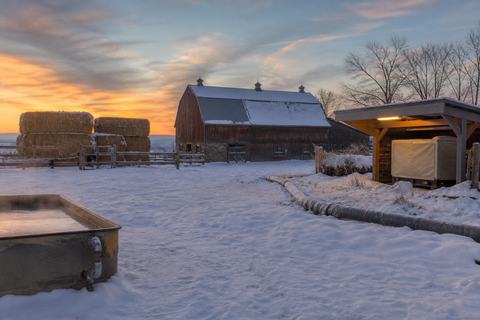
Most emergency binder templates are written for an apartment, not a homestead. They'll remind you to write down your insurance policy number — but they say nothing about the feed room, the water trough, or forty laying hens when the power's been out for two days.
If you're putting this together ahead of cold weather specifically, see our winterizing the homestead checklist — it covers the season-specific risks (frozen pipes, generator placement, cold-stressed livestock) that a general emergency binder doesn't dig into.
The documents that actually belong in the binder
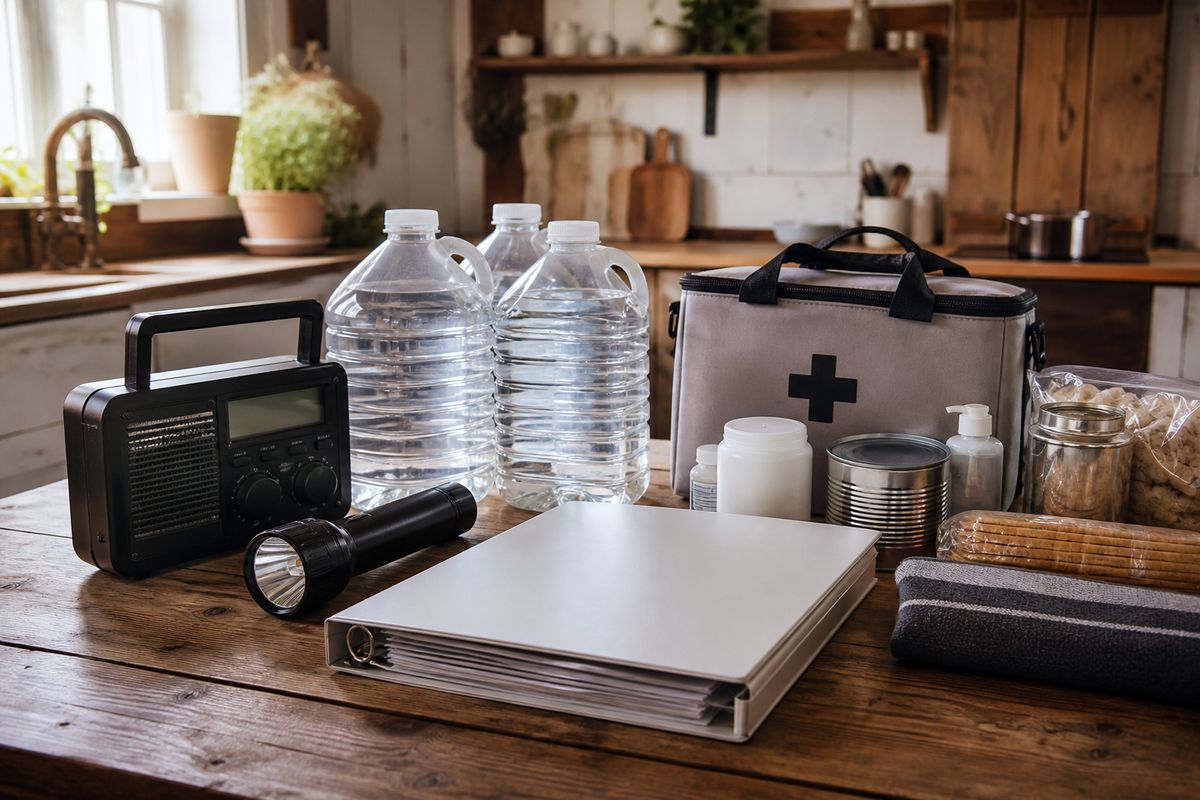
FEMA's Ready.gov financial-preparedness guidance (built around its Emergency Financial First Aid Kit, or EFFAK) is specific about what to gather and how to protect it:
- Insurance policies — property, health, and life — reviewed to confirm they actually cover the hazards your household and property realistically face.
- Deeds and property records, plus other important papers, medical records, and household contracts (the EFFAK is designed to help you inventory these systematically rather than from memory).
- Photos or video of your home and belongings, stored alongside the documents — useful for insurance claims after the fact, not just for prevention.
Where to keep all of it: Ready.gov recommends storing originals in a secure location away from home — a safety deposit box is the example it gives — and keeping copies of the key documents in your disaster supplies kit itself, so you're never relying on a single physical copy in a single location.
The water math most people skip
Ready.gov's water guidance is simple on paper — at least one gallon per person per day, for several days, covering both drinking and sanitation — but it's rarely translated into an actual number for a specific household. Needs rise in hot climates, for pregnant or nursing people, for anyone sick, and for pets, so the one-gallon figure is a floor, not a ceiling.
Worth doing once, in the binder itself: multiply your household's headcount by one gallon, then by the number of days you're planning to cover. A household of four planning for a week needs at least 28 gallons set aside — a number that's easy to underestimate until it's written down. Animal water is a separate reserve on top of this, not drawn from the same stored supply.
The power-outage food-safety clock
FoodSafety.gov's guidance gives exact numbers for how long refrigerated and frozen food actually stay safe once the power goes out — numbers worth having on the binder's inside cover, since they're hard to remember accurately under stress:
- Refrigerator: food stays safely cold for about 4 hours with the door kept closed.
- Full freezer: holds its temperature for about 48 hours with the door closed; a half-full freezer lasts about 24 hours.
- The discard rule: if the outage runs longer than 4 hours, discard refrigerated perishables — meat, poultry, fish, eggs, milk. Freezer food that's partially thawed can still be safely refrozen if it still has ice crystals or reads at or below 40°F.
- FoodSafety.gov's own summary of all of this: "When in doubt, throw it out."
The one detail worth writing down the moment the power fails: the actual time it went out. Both clocks above count from that moment, not from whenever you happen to check the fridge.
A livestock plan, since the standard binder doesn't have one
USDA's livestock emergency preparedness guidance fills a real gap — household emergency planning and livestock emergency planning are usually written as two completely separate documents, when a homestead needs both in the same binder:
- Identification: every animal should carry some form of ID — a microchip, an ear or leg tag, a leg band, or a tattoo — so ownership isn't in question if animals are displaced.
- An evacuation kit, kept current: feed, water, and supplements; medications; rope or a lariat, halters and leads; basic cleaning supplies and a knife; and veterinary records plus proof of ownership. USDA specifically flags reviewing this kit regularly, since feed and medication both go stale.
- The evacuate-or-shelter decision: the general rule is to plan to stay if it's safe to do so, and leave if ordered to evacuate — whether evacuation is realistic depends on the disaster type and on how safe and stable your shelter actually is.
- If you do leave: arrange a destination in advance — a friend or relative's property, a fairground — and decide ahead of time how animals will be transported and housed once there.
- If you're away when something happens: designate a neighbor who already knows your animals, your evacuation plan, where the kit is kept, and your emergency contacts.
- Shelter space: aim for roughly four times each animal's body size if sheltering in place.
USDA's own guidance is intentionally general on quantities — it only says supplies should be adequate if you can't reach your animals "for a day or so." That's exactly the kind of number worth replacing with your own specific feed and water figures once you've worked them out for your actual animals, rather than leaving the binder with a vague placeholder.
A binder built with the homestead section already in it
This article covers the reasoning; the Homestead Emergency & Self-Sufficiency Binder turns it into a 34-page, fill-in system — a water-storage worksheet, a power-outage food-safety chart, 72-hour go-bags, and a full Homestead & Livestock Emergency Plan with real per-animal feed/water figures, an evacuate-or-shelter framework, and a livestock evacuation kit checklist. Heading into cold weather specifically, pair it with the Homestead Winterizing Binder, and keep the pantry side of your plan current with the Canning Inventory & Pantry Log.
Browse the shop →