Growing Mulberries in a Backyard Garden: A Beginner's Guide
Mulberries are about as forgiving a fruit tree as exists — fast-growing, usually untroubled by pests, and happy in soil that would sulk a peach tree. The catch isn't growing one; it's picking the right kind and the right spot, since the wrong choice on either can mean a weedy, driveway-staining headache instead of a summer's worth of fruit.
For the fruit side of things once you've got a harvest coming in — jams, pies, drying — see our backyard berry patch guide and jam ratios guide.
Red, white, or something in between
Not every mulberry is the same plant, and the difference matters before you buy one. NC State Extension lists red mulberry (Morus rubra) as native to the eastern and central United States, hardy in USDA Zones 4a–9b, growing 25 to 60 feet tall with a dense, spreading crown. White mulberry (Morus alba), by contrast, was introduced from Asia for the silk industry and has naturalized aggressively across much of the country since — Purdue Extension's own publication on the species in Indiana calls it "truly a weedy species" that colonizes open, sunny sites via bird- and mammal-spread seed, and notes it's likely present in every county of the state. The two species also hybridize freely, which Purdue says has contributed to red mulberry's decline in parts of its native range.
Will one tree actually fruit?
This is the question beginners skip and regret skipping. Mulberries aren't all built the same way reproductively: an Extension expert answering through the Ask Extension service explains that some mulberry varieties are monoecious (one plant carries both male and female flowers and is self-fertile on its own), while others are dioecious, meaning separate male and female plants are needed before any fruit sets at all — and a tree that's strictly male will never produce fruit, no matter how well you care for it. Before buying, ask the nursery directly whether the specific variety or cultivar is self-fertile. Many of the named fruiting cultivars sold for home gardens are selected to be self-fertile, but an unlabeled seedling is a gamble.
Where to plant it (and where not to)
NC State's growing notes are blunt about siting: give it full sun for the best fruit, rich moist well-drained soil, and — above everything else — think hard about where the canopy and the dropped fruit will land. Mature red mulberry can reach 60 feet tall and 40 feet wide, and ripe fruit that birds don't eat first falls steadily through the harvest window. It stains concrete walkways, patios, and parked cars, and one commonly sold cultivar ("Townsend") is specifically flagged for dropping fruit on vehicles and driveways. Keep the tree well away from anywhere you park, sit, or walk barefoot, and keep young children's play areas clear of it too — NC State notes that unripe fruit and the tree's milky sap are mildly toxic, and the sap can cause contact dermatitis (ripe, fully colored fruit is harmless to eat).
Planting, pruning, and keeping it manageable
Mulberries grow quickly and need only light upkeep once established. NC State rates it medium-maintenance overall, but flags one real pruning rule: prune in late fall or winter, since cutting it while actively growing causes the tree to "bleed" sap heavily. If size is a concern — and on a full-size cultivar, it usually becomes one — a University of Florida IFAS Extension horticulture post on dwarf, repeat-fruiting mulberry varieties recommends light pruning between fruiting flushes rather than one hard annual cut: it keeps fruit within easy reach and helps build a sturdier branch framework, since mulberries can be vulnerable to wind damage when left to grow unchecked. Mulberries also self-seed prolifically; NC State notes that herbicides don't reliably stop volunteer seedlings, so hand-pulling them young is the practical fix if you don't want volunteers coming up in beds and fence lines nearby.
Pests and diseases: a short, manageable list
Compared to most fruit trees, mulberry's problem list is short. NC State's reference notes borers (especially in southern states), whiteflies that can mass on certain trees, and a handful of diseases — bacterial blight, coral spot cankers causing twig dieback, bacterial leaf scorch, powdery mildew, root rot, and occasionally "witches' broom." Scale, mites, and mealybugs round out the pest list. None of these typically threatens a healthy, well-sited tree the way fire blight or peach leaf curl threaten other fruit trees; mulberry's reputation as a low-input backyard tree is well earned.
Harvest: a tree that ripens over weeks, not all at once
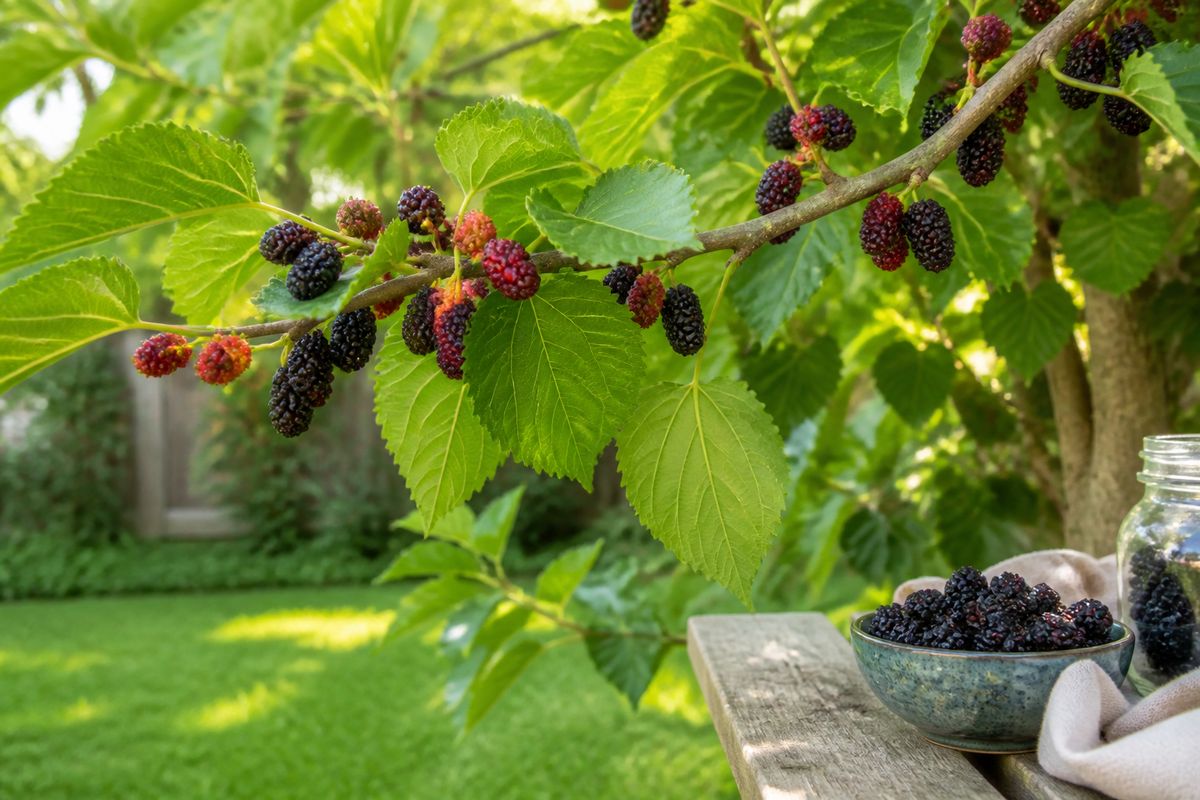
Unlike a crop you pick in one pass, mulberry fruit ripens unevenly along the tree over an extended window — Purdue's notes on red mulberry put fruit ripening from mid-June into July, and dwarf, repeat-fruiting cultivars can flush several times a year in milder climates. Because the fruit bruises easily and doesn't continue ripening once picked, most growers don't hand-pick berry by berry at all: once a branch is loaded with fully dark, ripe fruit, spreading a tarp or sheet beneath the tree and gently shaking the limb lets the ripe berries drop free while underripe ones stay put for the next round a few days later. This is also exactly why siting the tree away from hardscape matters so much — the same loose, easily dropped fruit that makes harvest easy is what stains a driveway if the tree is planted over one.
The short version
A mulberry tree is genuinely one of the lowest-maintenance fruit trees you can plant, but two decisions made before the shovel ever goes in the ground decide whether it's a win or a nuisance: pick a known, ideally self-fertile fruiting cultivar rather than an unidentified seedling, and site it somewhere its dropped fruit lands on grass or mulch, not concrete.
From one tree to a full harvest
Once the fruit starts coming in, The Homestead Mulberry Tree is a full guide to siting, pruning, and preserving a mulberry harvest, with 9 recipes built around the one problem every mulberry grower eventually hits: more ripe fruit than you can eat fresh.
Browse the shop →