
Jam & Pickle Ratios: A Beginner's Guide to the Fruit, Sugar, Vinegar & Salt Math
Jam and pickles both come down to a ratio, not a mood. Jam sets (or doesn't) based on how much pectin and acid the fruit itself brings to the pot versus how much sugar you add; a pickle brine is safe (or isn't) based on a fixed minimum of vinegar relative to water. Once you know the actual numbers, both stop being guesswork.
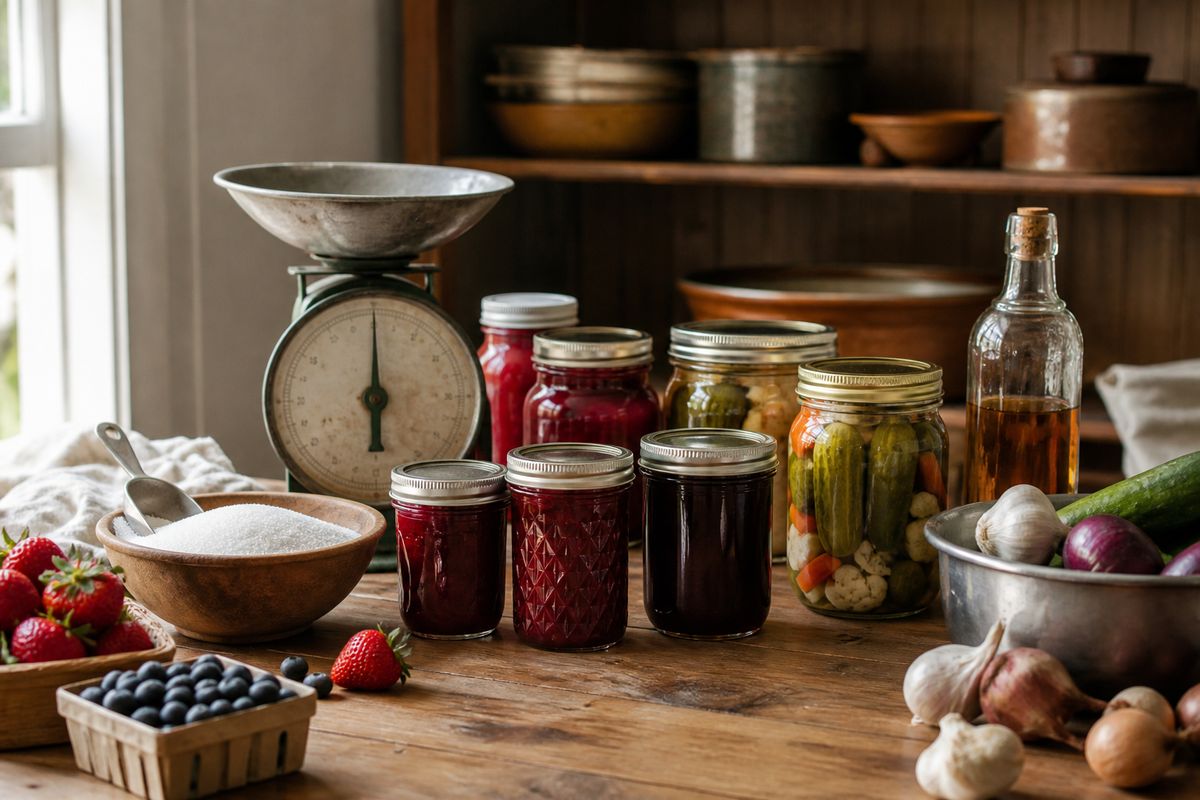
This is the chemistry behind the process; for the step-by-step water-bath and pressure-canning basics themselves, see our home canning guide.
What actually makes jam set
Three things have to be in the right balance for jam or jelly to gel: pectin, acid, and sugar. Penn State Extension's guidance on fruit acidity lays out the mechanism plainly: acid helps pull pectin out of the fruit during cooking, and without enough natural acidity in the fruit, a gel won't form at all, no matter how long you cook it.
- Naturally high in acid: citrus fruits, quince, grapes, regular (not Japanese) plums, kiwi, and pomegranate.
- Naturally low in acid: many berries, pears, peaches, apricots, and figs — figs are low enough that they typically need both added acid and longer processing.
- Naturally high in pectin: apples (and, separately, grapes are called out as very high in pectin too).
Acidity also isn't fixed — it varies by variety and drops as fruit passes its prime, which is part of why a batch of overripe fruit can refuse to set even when a recipe says it should. The practical fix for a low-acid fruit like peach or apricot is bottled lemon juice, added specifically to bring the acid level up to where pectin extraction actually works; Penn State also notes that pairing a naturally high-pectin fruit like apple with a lower-pectin one like pear, in a long-cooked no-added-pectin jam, can improve the set without needing a commercial pectin at all.
Jam without added pectin: the actual fruit-to-sugar ratios
The National Center for Home Food Preservation (NCHFP) publishes tested ratios for making jam relying only on the fruit's own pectin and acid — no store-bought pectin box required, provided you pick fruit that's about three-quarters ripe and one-quarter underripe (underripe fruit carries more natural pectin) and include some peel and core where the pectin concentrates most:
| Fruit | Crushed fruit | Sugar | Lemon juice | Yield |
|---|---|---|---|---|
| Apricots | 4 to 4½ cups | 4 cups | 2 Tbsp | 5–6 half-pints |
| Berries (blackberry, boysenberry, dewberry, gooseberry, loganberry, raspberry, strawberry) | 4 cups | 4 cups | — | 3–4 half-pints |
| Peaches | 5½ to 6 cups | 4–5 cups | 2 Tbsp | 6–7 half-pints |
Notice the pattern: berries, which are both naturally acidic enough and reasonably pectin-rich, need no added lemon juice at all. Apricots and peaches — both on the "naturally low in acid" list above — need it to set reliably.
Jelly without added pectin follows its own ratio, based on strained juice rather than crushed fruit: about ¾ to 1 cup of sugar per cup of juice, with crab apples at the higher end (1 cup) and apples or plums at the lower end (¾ cup) — apples being naturally pectin-rich enough to need less sugar help in reaching a set.
Testing for doneness without guessing
NCHFP gives two reliable tests rather than "cook until it looks right":
- Temperature test: boil until the mixture hits 220°F at sea level, dropping about 2°F for every 1,000 feet of elevation (205°F at 8,000 ft). This is the most precise method if you have a candy or jam thermometer.
- Refrigerator (plate) test: pull the mixture off the heat, spoon a small amount onto a cold plate, and chill it in the freezer a few minutes. If it gels on the plate, it's ready — and expect a bit more thickening as the full batch cools afterward.
Processing jam and jelly safely
NCHFP's boiling-water canner schedule for jars of jam or jelly (the schedule applies the same way whether or not pectin was added) is short compared to most other canned goods, and leaves ¼ inch of headspace in every jar:
| Altitude | Process time (half-pints or pints) |
|---|---|
| 0–1,000 ft | 5 min |
| 1,001–6,000 ft | 10 min |
| Above 6,000 ft | 15 min |
One safety note worth knowing before you improvise: NCHFP specifically warns against using commercially canned or frozen fruit juice for a no-added-pectin jelly, since their pectin content runs too low to reliably set — fresh or home-preserved juice only.
Pickle brine: a fixed ratio, not a "to taste" one
Unlike jam, where the ratio is mostly about texture and flavor, a pickle brine's vinegar-to-water ratio is a food-safety line, not a preference. Penn State Extension's quick-process pickle guidance is blunt about it: "Do not alter vinegar, food, or water proportions in a recipe." Their tested fresh-pack dill pickle brine runs about 3 parts 5% vinegar to 4 parts water (1½ quarts vinegar to 2 quarts water), plus ½ cup pickling salt in the brine itself and a separate ¾ cup salt dissolved in 2 gallons of water for a 12-hour pre-soak of the cucumbers.
Process times for raw-pack dill pickles in a boiling-water or atmospheric steam canner:
| Jar size | 0–1,000 ft | 1,001–6,000 ft | Above 6,000 ft |
|---|---|---|---|
| Pints | 10 min | 15 min | 20 min |
| Quarts | 15 min | 20 min | 25 min |
The short version
Jam is a ratio you can nudge: more or less sugar changes sweetness and set, and swapping in a low-acid fruit just means adding lemon juice to compensate. A pickle brine is a ratio you don't nudge: the vinegar-to-water proportion in a tested recipe is a minimum acid level, not a flavor choice, and it's the one place in home preserving where "I'll just eyeball it" stops being a quality issue and becomes a safety one.
The ratios, already laid out on your counter
This article covers the reasoning; the Jam & Pickle Ratios Chart puts the tested fruit-to-sugar and vinegar-to-water numbers on one printable reference you can prop up while you cook. Pair it with the Preserving Calendar to plan which fruits and vegetables come in when, or go deeper with The Homestead Canning Book for full recipes.
Browse the shop →More Food Preservation & Kitchen guides
- Sources:
- National Center for Home Food Preservation — Making Jam Without Added Pectin
- National Center for Home Food Preservation — Home Canning Guide, Jams & Jellies section
- Penn State Extension — Acidity Level of Fruit in Jam and Jelly Preparation
- Penn State Extension — Let's Preserve: Quick Process Pickles