Growing & Storing Garlic and Onions: A Beginner's Guide to Fall Planting and Winter Curing
Garlic and onions are both allium bulbs, both cured before storage, and both ruined by the exact same mistake — getting curing or storage temperature wrong. But they're planted on opposite schedules and triggered to bulb by completely different signals. Here's how to grow and store both, sourced from university extension vegetable programs.
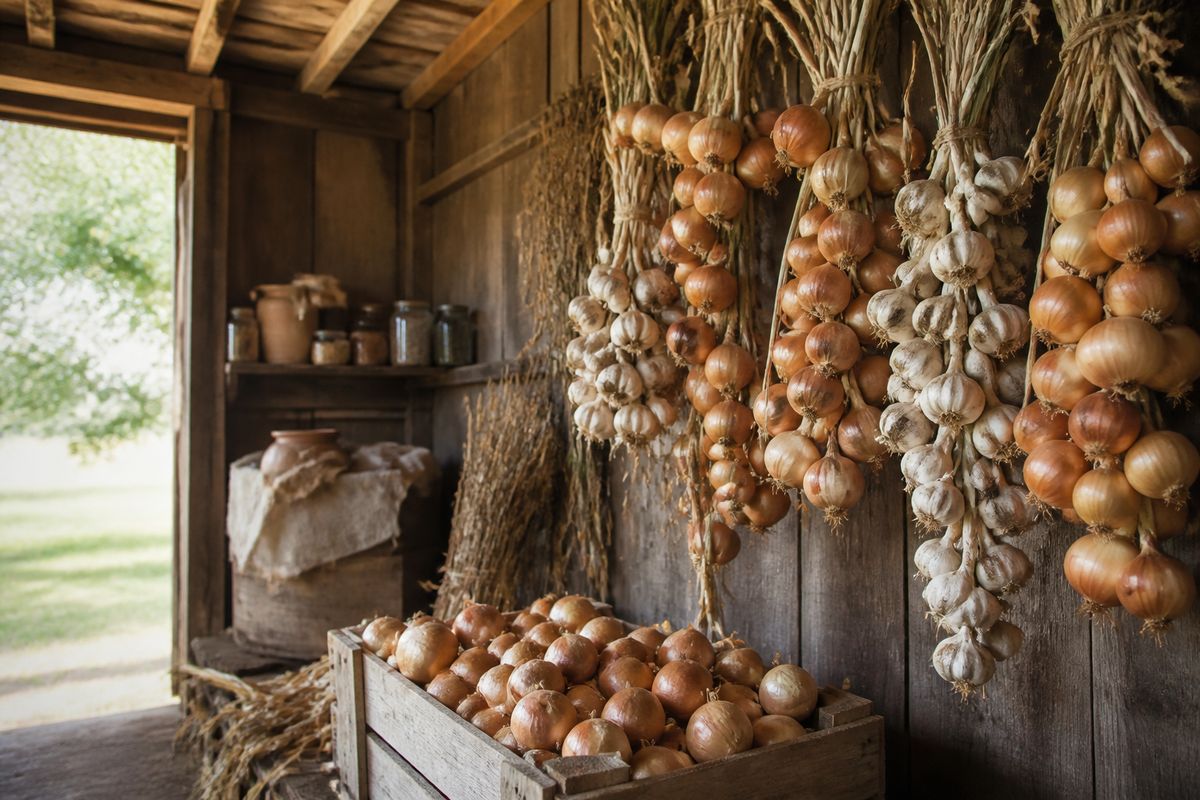
Already working out where this harvest will live all winter? Our root cellar storage guide covers the temperature/humidity zones every crop needs, and growing and storing potatoes covers the other classic fall-storage crop. This article is specific to garlic and onions, start to finish.
Pick the right stock — and the right type
University of Illinois Extension splits garlic into two types: hardneck, which is more cold-hardy, has the best flavor, and sends up an edible flower stalk called a scape; and softneck, which is less cold-hardy, stores longer, and has pliable stems you can braid — it's also the type sold in most grocery stores. Save your biggest, healthiest cloves for planting stock rather than buying grocery-store bulbs, which are often treated to resist sprouting.
Onions split by day length instead. University of Minnesota (UMN) Extension explains that long-day onions need 14 or more hours of daylight to form bulbs and are the type grown for storage in northern climates; short-day onions form bulbs on less daylight and tend toward smaller, milder bulbs that don't store as long. Most onion sets sold in northern garden centers are actually short-day varieties, which is worth checking before you plant a storage crop and get sweet, fast-spoiling onions instead.
Planting time, depth and spacing
Garlic goes in the ground in fall — Illinois Extension recommends 4 to 6 weeks before the ground freezes, so cloves root before winter dormancy without pushing top growth. Oregon State University (OSU) Extension gives a wider fall window, September through November. Separate cloves right before planting, leave the papery skin on, and plant with the pointed tip up, 1 to 2 inches deep and 4 to 5 inches apart, in rows 15 to 18 inches apart (Illinois Extension); OSU's numbers run close, 2 inches deep and 2 to 4 inches apart.
Onions go in the following spring, and you have three starting options per UMN Extension: sets (small bulbs grown the prior year), planted as soon as soil is workable; store-bought transplants, which tolerate a light frost and can go in around 50°F; or seed, sown 1/4 to 1/2 inch deep in rows 12 to 18 inches apart and thinned to 3 to 4 inches once seedlings emerge. Onions are shallow-rooted and need consistent moisture — at least an inch of water weekly, more in sandy soil — right up until the tops begin to fall over.
Scapes and daylength: two different "don't wait too long" signals
Hardneck garlic sends up a scape in spring. Both Illinois Extension and OSU recommend cutting it off so the plant puts its energy into the bulb instead of a flower — the scapes themselves are good eating, with a mild garlic flavor that works well in pesto. Leave scapes on a few plants if you want to try braiding or need the stem length for hanging.
Onions don't have a scape to manage, but they have their own trigger to watch: bulbing itself is set off by daylength, not by anything you do in the garden. An overcast, cool stretch can delay bulbing even once the calendar says it's time — UMN Extension notes this is normal and not a sign of a failing crop, just a reason bulb size can vary season to season.
Knowing when to stop and dig
The University of Massachusetts (UMass) Extension vegetable program is specific about garlic: harvest when roughly 60% of the leaves are still green — a rule of thumb is at least three leaves that haven't browned at the tips — and when in doubt, harvest a touch early rather than late, since bulbs left too long in the ground start to split apart in their wrappers and store poorly. Cut one bulb sideways to check: if the cloves are still loose inside the wrapper, give it more time.
Onions give the opposite signal. UMN Extension's harvest rule is to wait until about half the tops have fallen over and begun to dry, then undercut and lift the bulbs with a spading fork rather than pulling, which can bruise them.
Curing — the step that decides whether storage works at all
This is where garlic and onions genuinely diverge, and it's worth getting each one right rather than treating them the same.
Garlic: UMass Extension's curing data (Callahan et al.) is detailed enough to plan around. Keep bulbs below 90°F during curing and out of bright sun — garlic dries well at 110°F, but waxy breakdown starts around 120°F. Curing is done when the outer skins are dry and crisp, the neck is constricted, and the center of the cut stem is hard. How long that takes depends on both temperature/humidity and neck thickness:
| Temperature | Relative humidity | Days (necks 2–3") | Days (necks 6–7") |
|---|---|---|---|
| 80°F | 90% | 19 | 33 |
| 80°F | 70% | 11 | 19 |
| 105°F | 90% | 7 | 9 |
| 105°F | 70% | 6 | 7 |
For a typical backyard setup with no climate control, that lands on roughly 10 to 14 days in a warm, dry, well-ventilated space out of direct sun — a garage, covered porch, or barn with a fan running works. Illinois Extension's simpler version: plan on 4 to 6 weeks if conditions are less than ideal.
Onions: UMN Extension recommends curing in a warm (75–90°F), well-ventilated spot for 2 to 4 weeks. Curing is complete when the outer scales are dry and the neck is tight; skipping this step or rushing it is the single biggest cause of onions rotting in storage rather than keeping. Braid them or trim the tops once fully cured.
Long-term storage: the numbers that matter (and the mistake to avoid)
UMass Extension's storage table for garlic gives real numbers to plan around: short-term storage (1–2 months) at 68–86°F and under 75% relative humidity; long-term storage (6–7 months) at a cold 30–32°F and 60–70% humidity — essentially commercial cold-storage conditions most home growers can't replicate. The mistake worth avoiding: a standard refrigerator runs 35–40°F, right in the range where UMass warns cloves break dormancy fastest and start sprouting. OSU Extension agrees — don't refrigerate garlic. For most backyard growers without walk-in cold storage, the realistic plan is a cool room-temperature spot (60–65°F), dark, dry, and well-ventilated, in mesh or paper bags rather than plastic, which gets 4 to 8 months depending on variety and cure quality.
Onions run the opposite way: UMN Extension notes onions sprout if kept above 40°F, so the goal is the coldest storage you can manage without actually freezing them — a cold basement, an unheated room, or a refrigerator crisper drawer for smaller quantities. That's the inverse of garlic's refrigeration rule, which is exactly why it's worth learning both numbers rather than assuming one storage spot suits every allium in the pantry.
Whichever bulb you're storing, set aside anything bruised, soft, or thin-skinned to use first — both OSU and UMass note that damaged bulbs break down fastest and can spread rot to whatever's stored next to them.
The short version
Garlic: plant cloves in fall, 1–2 inches deep, cut the scapes, harvest at ~60% green leaves (early beats late), cure 10–14+ days warm and dry, then store cool-room-temperature (never in the fridge) for months, not weeks. Onions: plant sets or transplants in spring, stop watering once tops fall, cure warm (75–90°F) for 2–4 weeks, then store as cold as possible without freezing. Same family, same curing-before-storing principle, opposite temperature rules at the end.
Printable tools for the harvest-to-pantry stretch
The Root Cellar Storage Chart puts the temperature and humidity numbers for garlic, onions, and every other crop on your wall, and the DIY Buried Barrel Root Cellar Guide builds the actual cool storage space these bulbs need. Planning next year's bed rotation and fall planting dates? The Homestead Garden Master Planner covers frost dates, bed layout, and a full harvest log in one system.
Browse the shop →