Canning vs. Freezing vs. Dehydrating: A Beginner's Guide to Choosing the Right Preservation Method
A big harvest doesn't come with instructions for what to do with it. Canning, freezing, and dehydrating all "preserve" food, but they trade off nutrients, shelf life, equipment cost, and safety risk very differently — and the method with the longest shelf life isn't the one most beginners assume.
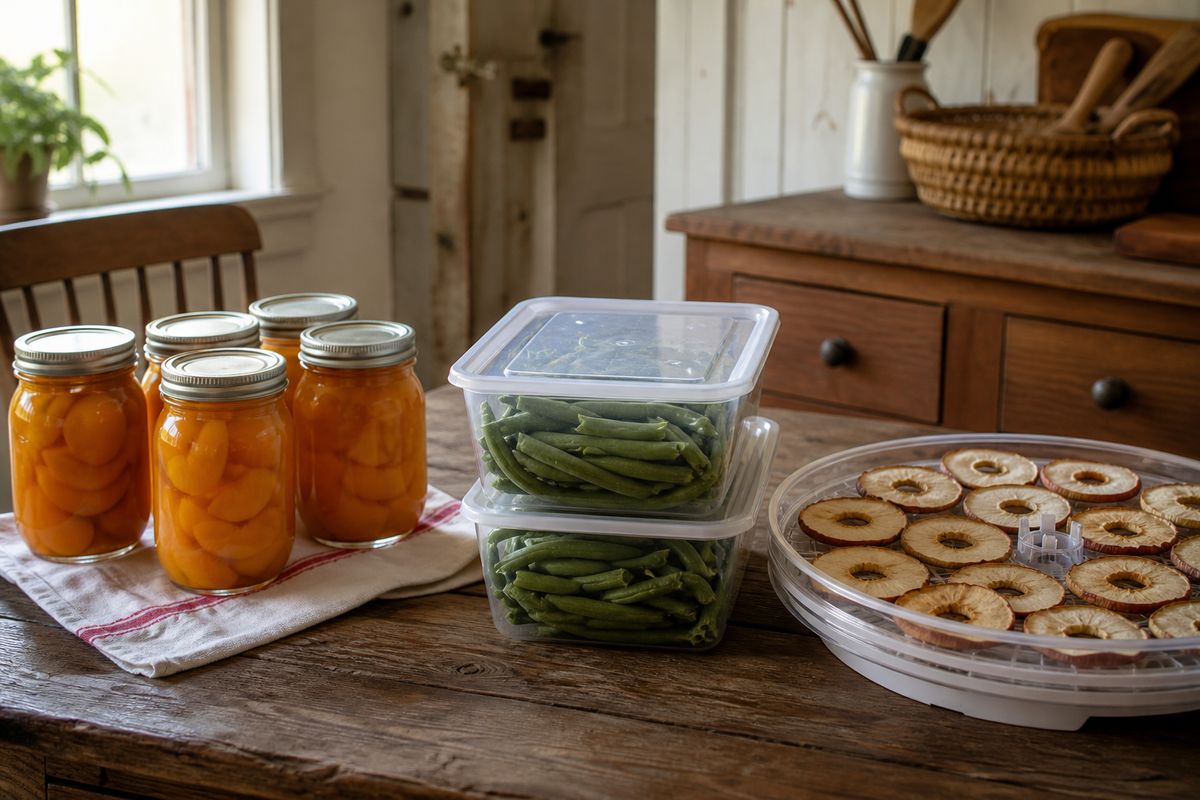
Already sold on canning specifically? Start with our home canning basics guide or home food dehydrating guide for the step-by-step process. This article is for deciding which method to reach for in the first place.
The three methods, compared at a glance
The University of Alaska Fairbanks (UAF) Cooperative Extension Service rates all three methods head-to-head on four factors that matter most to a beginner deciding where to start:
| Factor | Canning | Freezing | Dehydrating |
|---|---|---|---|
| Ease of use | Intermediate | Best | Hardest |
| Equipment cost | Best (lowest) | Worst (highest) | Intermediate |
| Nutrient retention | Intermediate | Best | Worst |
| Shelf life | Best (longest) | Intermediate | Worst (shortest) |
The one most beginners get backwards: dehydrated food doesn't last the longest just because it's shrunk down and dried out — of the three, UAF actually rates its shelf life the shortest. Canned food, sealed and heat-processed, is the one that holds up longest at room temperature. Freezing splits the difference on almost everything, which is exactly why it's the method most people reach for by default — it's the easiest to do right and keeps the most nutrients, at the cost of needing freezer space and power you can rely on for months or years.
What each method actually requires
Equipment is often the real deciding factor, more than any of the numbers above:
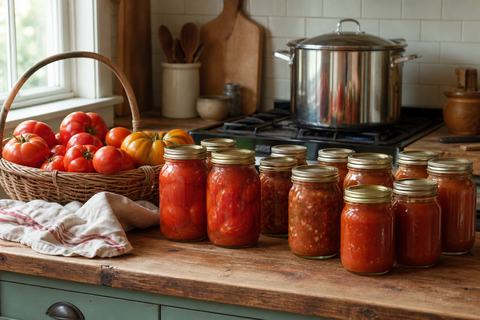
- Canning: a boiling-water canner for high-acid foods, or a pressure canner for low-acid foods. UAF notes a small pressure cooker can sometimes substitute for a pressure canner, but only if it can hold four quart jars on a rack with enough room for steam to circulate freely around them.
- Freezing: freezer space and, per UAF, a dependable power source — this is the method's real cost, both the appliance itself and the ongoing electricity, and a prolonged power outage is the one failure mode that can undo months of work at once.
- Dehydrating: a dehydrator, a conventional oven, direct sun, a solar dehydrator, or a freeze dryer — UAF lists all five as workable options, which is part of why its equipment cost rates as merely "intermediate" rather than highest.
Matching the method to the food, not the other way around
UAF's guidance splits canning itself into two tracks depending on acidity: high-acid foods (fruits, rhubarb, sauerkraut, and vinegar-based pickles and relishes) are safe in a boiling-water canner, while low-acid foods (vegetables, meats, poultry, seafood, mushrooms, and soups) need the higher heat only a pressure canner reaches. Freezing and dehydrating both rely on blanching first for most vegetables — a quick dip in boiling water or steam that inactivates the enzymes that would otherwise keep breaking food down even at freezer or drying temperatures, degrading color, texture, and nutrients over time.
Some foods genuinely suit one method better than the others rather than being equally fine in all three. Zucchini is the clearest beginner example: it freezes well as slices or shredded for baking, dries into crisp chips or fruit-leather-style snacks, but has no safe boiling-water canning method of its own — zucchini pickles and relishes are the actual tested canning route for that vegetable, not plain canned zucchini. When in doubt about whether a specific food has a tested method at all, the National Center for Home Food Preservation is the reference to check before improvising.
The safety line that matters more than preference
Each method fails in a different way when done wrong, and none of the three failure modes are things you can judge by taste or smell:
A simple way to decide
If you want the longest unrefrigerated shelf life and the lowest equipment cost, and you're willing to follow a tested recipe exactly rather than improvise — canning is the method built for that trade-off. If you want the easiest process and the best nutrient retention, and you have freezer space and reliable power to commit to it — freezing wins on both of those factors in UAF's own ratings. If you want lightweight, shelf-stable snacks and don't mind the shortest storage life of the three, or you're working with a harvest too large to can or freeze all at once — dehydrating stretches your options furthest with the least specialized equipment. Most homesteads that put up a real harvest end up using all three, picking the method crop by crop rather than committing to just one.
The short version
Freezing keeps the most nutrients and is the easiest to get right; canning keeps food the longest at room temperature and costs the least in equipment; dehydrating is the lightest and most portable but has the shortest shelf life of the three. None of that matters more than matching the method to what a tested, research-based source actually says is safe for that specific food — the "best" method is always the one with a tested recipe for what's actually sitting on your counter.
Printable references for whichever method you pick
This article covers the trade-offs; The Homestead Canning Book (56 pages, 25 tested recipes) and the Dehydrating Book go deep on each method individually, or get both directions covered at once with the Dehydrating Times & Temps Chart and the full Kitchen Reference Charts Bundle (8 printable charts in one set). If canning is your pick, the Preserving Starter Bundle pairs the canning book with three printable reference charts. Not ready to process everything at once? Our root cellar storage guide covers the fourth option — keeping produce fresh without canning, freezing, or drying it at all.
Browse the shop →