Building a Chicken Tractor: A Beginner's Guide to Mobile Coops
A chicken tractor is a bottomless, movable pen that gives birds fresh ground every day instead of one fixed yard. Done right, it's one of the simplest ways to raise healthier birds, build soil fertility, and cut down on the parasite and manure buildup a stationary run always accumulates. Done wrong, it's an unventilated box that's easy for a determined predator to get into.
This is a construction-focused companion to our guide on how to start a backyard chicken flock and to building a backyard chicken coop — those cover a fixed coop and run; this one covers the pen you move.
What a chicken tractor actually is
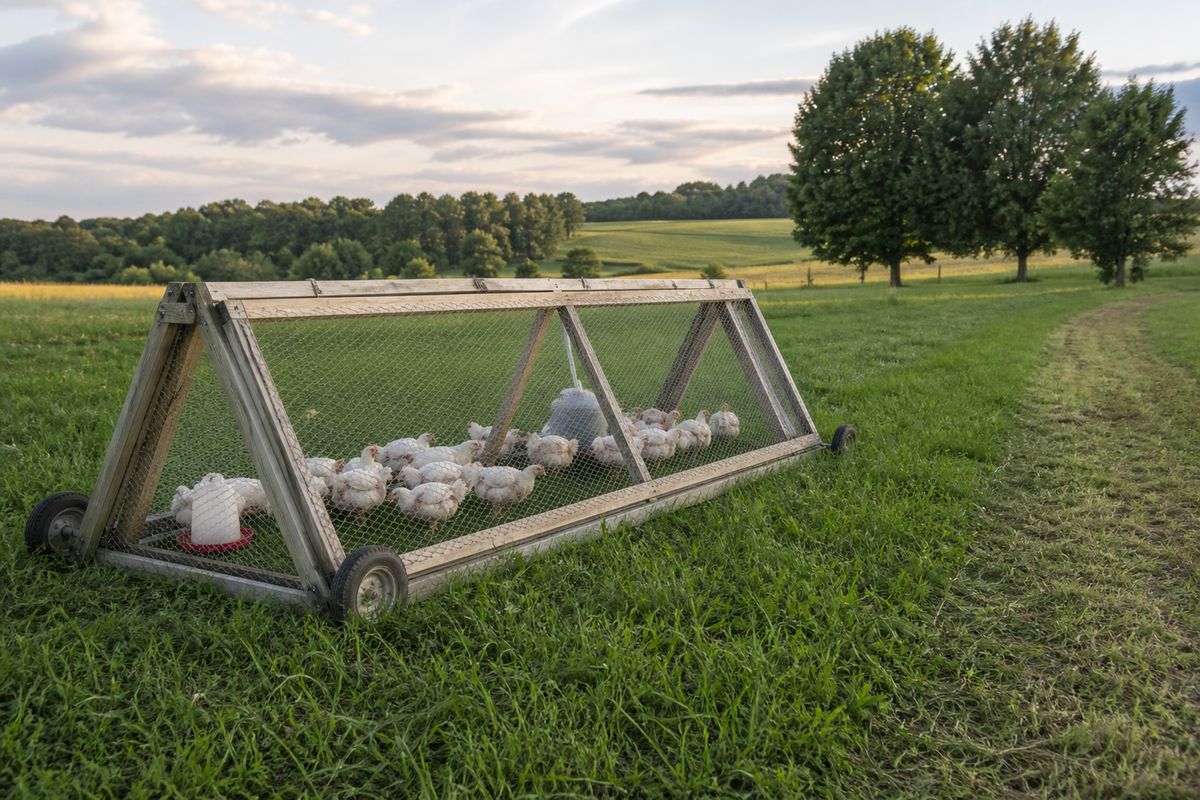
A chicken tractor is a lightweight, floorless pen — usually built on skids or wheels so one or two people can drag or roll it — that sits directly on pasture or garden ground and gets relocated on a schedule, most often daily. Oregon State University Extension's pastured-poultry program describes the design simply: it can be "a pen for day use, or have a mobile house or small runs attached," and it's used primarily "on a small-scale in gardens for fertility, weed and pest control and tillage." The birds graze and scratch a small patch of ground hard for a day, then move on before they strip it bare or build up manure past what the soil can handle.
How much space your tractor actually needs
Oregon State's benchmark pen is a 4×10 ft structure (40 sq ft), and its stated capacity makes the per-bird math straightforward:
| Bird type | Birds in a 4×10 ft (40 sq ft) pen | Floor space per bird |
|---|---|---|
| Broilers (meat birds) | 20 | ~2 sq ft |
| Layers | 10 | ~4 sq ft |
Layers need roughly double the floor space broilers do in the same tractor, mostly because they're kept longer and are more active — broilers mainly eat and rest until processing weight, while layers need enough room to move around comfortably for months. Scale the numbers up or down from this ratio for a different pen size, and always round down rather than up if you're between two flock sizes — crowding is the single fastest way to turn a tractor into a stress, pecking, and disease problem.
Why the daily move matters
- Fresh ground every day. Oregon State's guidance is explicit that tractors "should be moved daily on fallow beds" — this is the core of the system, not an optional extra.
- No manure buildup. A pen that doesn't move concentrates droppings in one spot fast enough to burn the grass and build up parasite loads in the soil; moving daily spreads that fertility (and that risk) thin across a much larger area.
- Pest and weed control. Birds scratch and peck a plot clean of insects, weed seedlings, and slug/grub populations before being moved off it — this is the "tillage" effect extension programs reference, useful ahead of planting a garden bed.
- Built-in rotation. Because the pen only stays on one patch for a day, you get a natural rest-and-recovery cycle for the pasture without having to manage separate paddocks and gates the way a fixed-fence rotational system requires.
Predator-proofing a mobile pen
- Mesh size: standard-weight ½–1 in. wire mesh at 5–6 ft height on any wall a predator could reach — ordinary chicken wire is for keeping birds in, not predators out.
- Cover the top completely with lightweight mesh. An uncovered top is an open invitation to hawks and owls, which take birds from open-top pens regularly.
- Stop digging at the edges. Since a tractor has no foundation, the bottom edge is the weak point. Options drawn from predator-prevention guidance: an apron of mesh laid flat on the ground around the perimeter and pegged down, or an angled apron (mesh at roughly 45° from the base, covered lightly with soil or sod) — both work by giving a digging animal nothing to get a grip on at the base rather than a straight edge to tunnel under.
- Lock it up at night. Make sure every door and access panel closes tightly and latches securely once birds are inside — most predator losses happen after dark, and a simple hook-and-eye latch isn't enough; raccoons in particular can work one open.
- For coyotes specifically: a jumping coyote is stopped by a 90° overhang (6–18 in. wide) at the top of the fence, or by adding a strand of high-tensile wire above the fence line; a digging coyote is stopped by one electrified high-tensile wire run about 6 in. above ground level, just outside the pen.
Design basics that make a tractor work day to day
- Keep it light enough to actually move. A tractor you dread dragging is a tractor that stops getting moved daily, which defeats the entire design. Skids or a simple axle-and-wheel kit (lifting one end to roll on wheels, setting back down flat to sit stable) are the two common approaches.
- Shade and shelter. Birds need to get out of direct sun and rain; a solid or tarped section over part of the pen (not the whole roof, which blocks airflow) covers this without sacrificing the open-mesh ventilation the rest of the structure needs.
- Feed and water access from outside. Built-in feeder and waterer ports let you service the flock without opening a door every time — fewer door openings means fewer chances for a bird to escape or a gap to be left unlatched.
- Size it to what you'll actually tow. A 4×8 or 4×10 ft footprint is the sweet spot most small-scale guides converge on — big enough to matter, small enough for one or two people to relocate without machinery.
Full build plans, ready to follow
Complete framing, wheel-kit, and predator-apron plans are in the shop: the Homestead Chicken Tractor Build Guide — a 4×8 ft wheeled, floorless pen sized for 6–8 hens or 15–20 broilers. Already keeping a flock in a fixed coop? The Homestead Chicken Coop Build Guide and the Chicken Flock Record Book cover the stationary side of the system.
Browse the shop →More Chickens & Poultry guides
Free tool: Chicken coop size calculator →