Building a Backyard Chicken Coop: A Beginner's Guide to Space, Nest Boxes & Predator-Proofing
Most coop problems trace back to the same two mistakes: not enough space for the number of birds you actually keep, and predator-proofing that looks secure but isn't. Both are solvable with the same handful of numbers university extension poultry programs have published for decades.
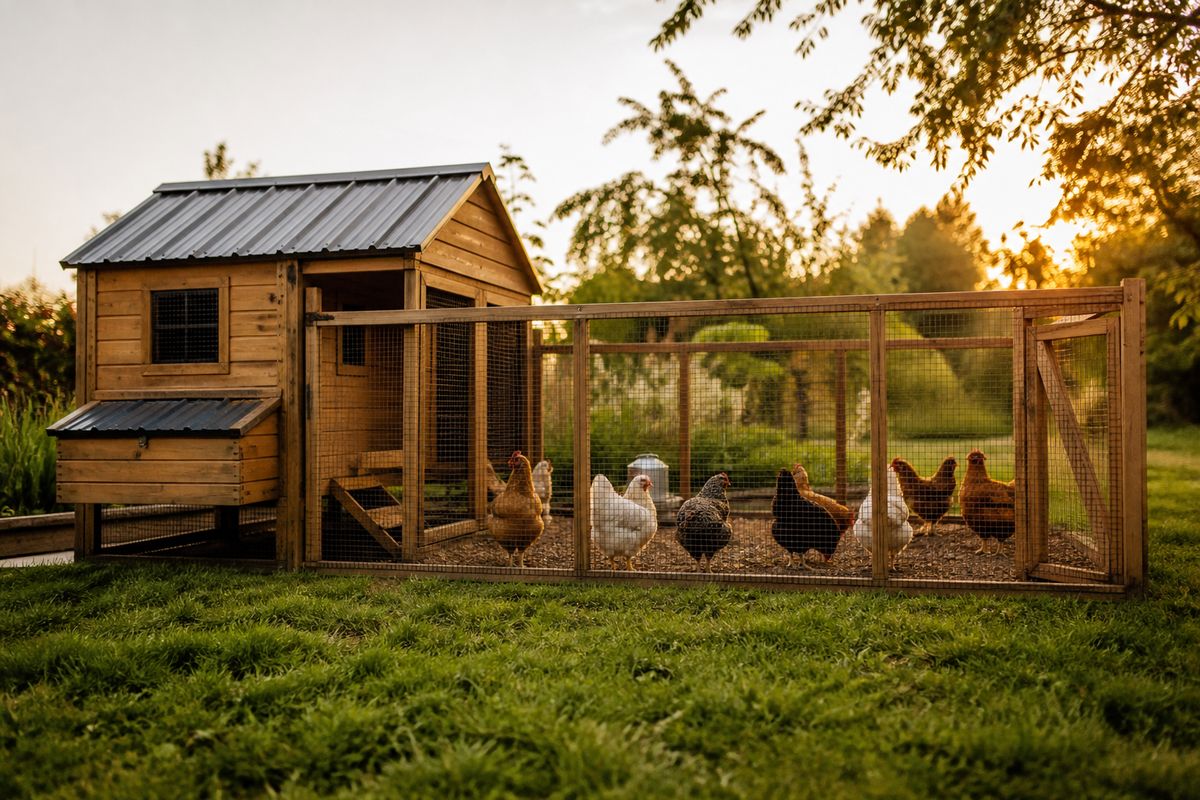
This is a construction-focused companion to our guide on how to start a backyard chicken flock — that guide covers breed choice, brooding, and feeding; this one covers building the coop itself.
How much space your coop and run actually need
Space requirements get confusing because the right number depends on whether birds have outdoor access. Penn State Extension's figures for the coop interior alone:
| Bird type | Interior floor space per bird |
|---|---|
| Large chickens | 2 sq ft |
| Laying hens | 1.5 sq ft |
| Bantam chickens | 1 sq ft |
Oregon State University Extension frames the same question around outdoor access, and the gap between the two scenarios is large: 3 sq ft per bird inside the coop if birds also have a run or outdoor area, versus 8 to 10 sq ft per bird if the coop is the only space they'll ever have. The practical takeaway: a small coop is perfectly fine as long as it's paired with a real run — skimping on both at once is what causes crowding, feather-picking, and disease.
Nest boxes
- Size: at least 12 in. × 12 in. × 12 in. per box.
- Count: two nest boxes for the first four hens, then one additional box for every four hens after that.
- Placement: at least 2 ft off the ground and at least 4 ft away from the roosts, positioned above the roosting poles so droppings don't collect in them overnight.
- Details that matter: a 3–4 in. lip across the front keeps nesting material and eggs from spilling out, and about 2 in. of clean, dry nesting material should stay in each box.
Roosts
| Bird type | Roost space per bird | Roost height |
|---|---|---|
| Standard breeds | 5–10 in. | 18–24 in. off the floor |
| Bantams | 4 in. | 12–18 in. off the floor |
Use 1–2 in. square lumber with the top edges rounded over (a flat perch is easier on a chicken's feet than a round dowel), space multiple roosting poles about 10 in. apart, and never build a roost higher than about 4 ft — extension guidance warns that higher roosts increase the risk of leg and foot injuries from birds jumping down.
Predator-proofing: the details that actually matter
- Bury the perimeter wire at least 12 in. deep around the pen, and bend the buried portion outward about 6 in. ("toeing it out") so a digging predator hits a dead end instead of a straight edge — this is the single most-skipped predator-proofing step.
- Raise the coop itself at least 1 ft off the ground, which removes the space predators would otherwise den in underneath it and makes burrowing in from below much harder.
- Cover the run on top with mesh wire or netting — aerial predators (hawks, owls) take birds from open-top runs regularly.
- Consider a solid footer — a concrete floor or slab, or starting the coop wall with one or two courses of concrete block, gives nothing for a predator to dig through at the base at all.
- Latches, not hooks: use a predator-proof latch (a carabiner or a two-step latch) on every door — raccoons in particular can operate simple hook-and-eye latches.
Siting, ventilation, and flooring
- Site: build on high, well-drained ground, and face the front of the coop south for warmth and faster drying after wet weather.
- Ventilation: windows or vents on one side are usually enough for a small coop — angle inlets upward and keep them away from the prevailing wind direction so you get airflow without a direct draft on the birds.
- Flooring: slope the floor slightly toward the door for easier cleaning, and use slats spaced about 3 in. apart (or a textured surface) on any ramp so birds don't slip.
- Final safety pass: before birds move in, check the whole structure for loose or ragged wire, protruding nails, or other sharp edges.
Full framing & predator-proofing plans, ready to follow
A 73-page, step-by-step picture manual for a walk-in run and raised coop for 10 hens, with a cutting diagram for every board, is in the shop: the Homestead Chicken Coop and Run Build Manual. It is made for first-time builders, one simple job per illustrated step. Already raising a flock? Track feed, laying, and health with the Chicken Flock Record Book.
Browse the shop →More Chickens & Poultry guides
Free tool: Chicken coop size calculator →