
Raising Meat Goats: A Beginner's Guide to Breeds, Feeding & Parasite Management
A meat-goat herd and a dairy herd share a species but not much else day to day: meat goats need less shelter, less particular feeding, and no milking schedule — but they come with their own specific risks around diet-caused urinary blockages and internal parasites that a dairy-focused guide won't cover.
If you're choosing between goats for milk or goats for meat, start with How to Start Raising Backyard Dairy Goats for the dairy side; this guide picks up where that one leaves off for a herd raised to grow and finish rather than to milk.
Choosing a breed
Oklahoma State University Extension's breeds program and the Oklahoma Basic Meat Goat Manual cover three breeds most beginners end up choosing between:
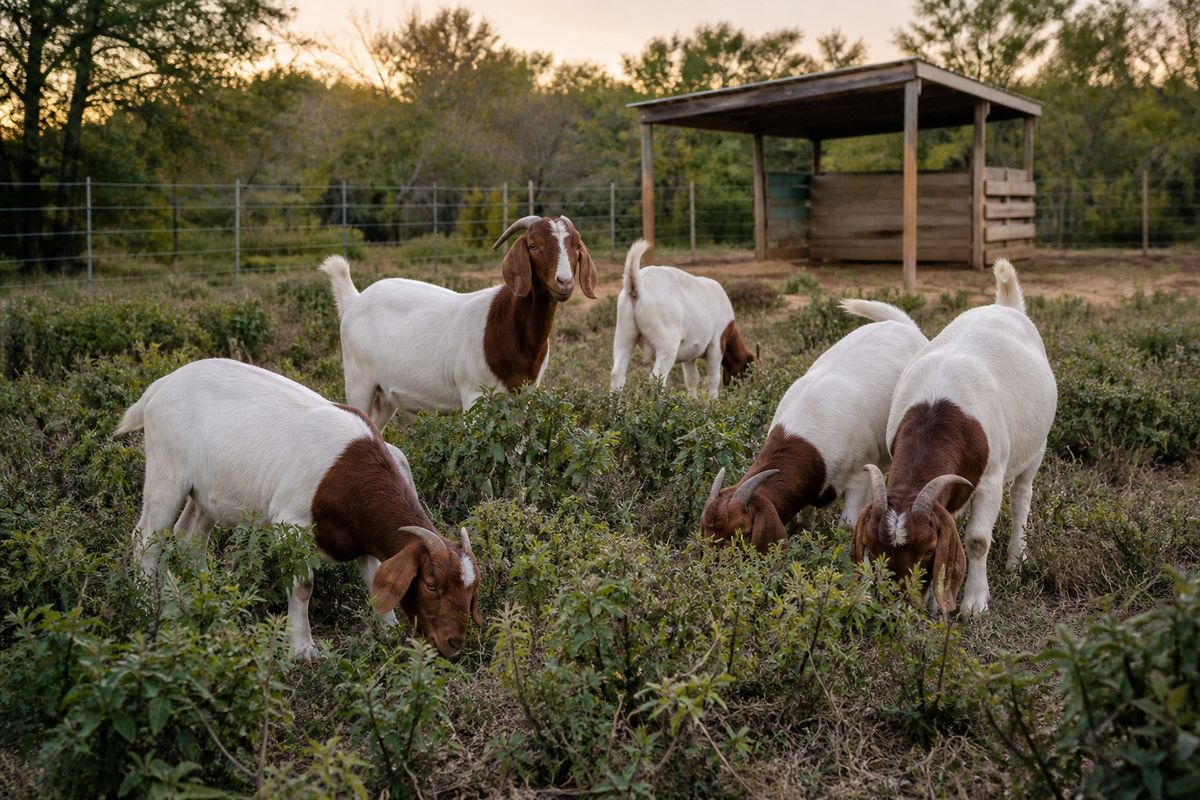
- Boer — an improved South African breed developed specifically for meat production and the first goat breed included in that country's national meat performance testing. Typical feedlot gain runs 0.3–0.4 lb per day, with exceptional individuals topping 0.44 lb per day. Mature bucks run 240–300 lb and does 200–225 lb. Boer does are prolific — a 200% kidding rate is common, with weaning rates exceeding 160% — and an extended breeding season makes three kiddings in two years possible. Boer is also the breed sale-barn buyers tend to prefer, which matters if you're selling through that channel.
- Kiko — developed in New Zealand from the 1980s specifically for hardiness with minimal input, and in the U.S. only since about 1995. Kikos are aggressive foragers that gain weight well under natural conditions with little or no supplemental feed, and does can conceive, kid, and raise multiple kids with little intervention even in less-than-ideal conditions. A 2004 Tennessee State University study found Kikos may be more parasite-resistant than Boers and had fewer foot-rot problems — and weaned more pounds of kid per doe than Boer goats did in that same study.
- Spanish and other landrace types — covered in the same Oklahoma manual as a third option: generally hardy, low-input goats bred more for rustic adaptability across a range of conditions than for maximum growth rate. Worth considering if your land and climate are the deciding factor rather than fastest time to market weight.
Housing and fencing: lighter than you'd expect
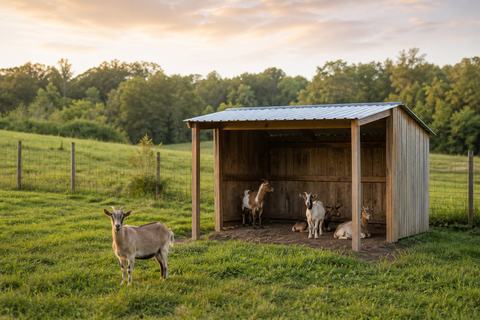
NC State Extension is direct about this: meat goats need less shelter than dairy goats, and a dry, open-sided shed is usually all the protection a healthy adult needs outside of extreme weather. Exact space-per-animal numbers, shed orientation, and bedding depend on your climate and herd size — the Goat & Sheep Loafing Shed guide covers that sizing in full rather than repeating it here.
Fencing is the part meat goats don't get a pass on. The Agricultural Marketing Resource Center describes goats as needing genuinely tight fencing — options that actually hold them include net fencing, traditional woven wire with two to three strands of barbed wire above it, or an eight-strand high-tensile fence with the third, fifth, and top wires electrified. A fence built to cattle or sheep standards is very often not tight enough for a goat that's decided to test it.
Feeding for growth without causing urinary calculi
Urinary calculi — mineral deposits that block the urethra — is one of the most common ways a well-fed meat-goat kid, especially a wether (castrated male), ends up at the vet or dead. Cornell's NYS 4-H goat program is specific about the fix, and it's a feeding ratio, not a medication:
- Keep calcium at roughly twice phosphorus in any grain ration. Grains like corn, oats, and wheat run high in phosphorus on their own, which is why limestone or another calcium supplement is often added back in — check both your grain and mineral labels for a stated ~2:1 calcium-to-phosphorus ratio rather than assuming.
- Check the label for ammonium chloride. Many commercial feed mills already add roughly 15 lb per ton. If it isn't listed, top-dress the grain yourself at about 1 teaspoon per pound of grain, up to 1 tablespoon per day — and talk to a vet about dose if you're unsure.
- Water, exercise, and salt matter as much as the ration. Plenty of water, exercise, and a salt-containing mineral mix all encourage drinking, which helps flush the system. Keep water shaded in summer heat and unfrozen (offered warm a few times a day if needed) in winter — a goat that won't drink because its water is too cold or too hot is at higher risk.
- Mature wethers doing light work on decent forage often don't need grain at all. It's growing kids that typically do.
- Watch for straining. A healthy goat stretches and urinates easily right after standing up from rest; straining or failing to urinate is a reason to call a vet immediately, not to wait and see.
For the actual growth ration once a kid is on feed, the Mid-Atlantic 4-H Market Goat Project Guide gives a workable framework: start arriving kids on about 0.25 lb of a complete 16% protein meat-goat ration plus free-choice hay, then increase the grain by no more than 0.25 lb per head per day — and only once the last feeding was fully cleaned up — until reaching a full feed of 1.5–2.5 lb per goat per day, which can take several weeks. Expect roughly 5–7 lb of feed per pound of gain at a typical 0.3 lb/day growth rate.
Weaning and realistic market weights
Kids are typically born in late winter or early spring and weaned around three months of age, per the same 4-H guide. From there, market and show weight targets vary by program and buyer, but a working example target of 80 lb with healthy goats gaining about 0.3 lb/day gives a sense of the math:
| Time to market | Weight to start at |
|---|---|
| 60 days out | 62 lb |
| 90 days out | 53 lb |
| 120 days out | 44 lb |
| 150 days out | 35 lb |
The Agricultural Marketing Resource Center also notes two different market products worth knowing the terms for: cabrito, meat from a kid harvested within its first week of life, and chevon, meat from an older kid harvested close to or after weaning — the two aim at different buyers and different carcass sizes. Does themselves can kid roughly twice a year, with a gestation period of 147–150 days, so a breeding calendar built around that interval is realistic for a doe in good condition.
Parasites: the FAMACHA eye check
Internal parasites, especially the blood-feeding barber pole worm, are one of the most consistent health problems in goats on pasture — and the FAMACHA© system (developed for exactly this) lets you check for the anemia they cause without a lab test. You match the color of the goat's lower eyelid membrane against a laminated reference card, scoring 1 (not anemic) to 5 (severely anemic), always using the pinkest part of the membrane and the higher of the two eyes if they differ.
- Score 4 or 5: always deworm.
- Score 3: deworm if the animal is a kid, is pregnant or lactating, is in poor body condition, or if more than 10% of the herd is scoring 4 or 5 — when in doubt, treat.
- Score 1 or 2: don't deworm unless you're also seeing other signs, like diarrhea or a dull, rough coat.
Check scores every two weeks during the grazing season (you can stretch that to three or four weeks in spring and fall, and further in winter, though does and ewes need closer watching around kidding). If more than 10% of the herd scores 4 or 5, treat every animal scoring 3 or higher and move the herd to a different pasture if you can — animals recover fastest off the heavily infected ground, and returning treated goats to the same pasture risks reinfecting them from larvae still there.
Track the herd you're building
The Goat Herd Record Book gives you the breeding, kidding, and health log to put this guide's feeding ratios, weaning dates, and FAMACHA checks into practice day to day. When you're ready to build the shelter itself, the Goat & Sheep Loafing Shed Build Guide has the full step-by-step picture-manual plans.
Browse the shop →More Goats, Sheep, Pigs & Cows guides
Free tool: Fence cost calculator →
- Sources:
- Oklahoma State University — Breeds of Livestock: Boer Goats
- Oklahoma State University Extension — Oklahoma Basic Meat Goat Manual
- eXtension Goat Breeds — Kiko
- NC State Extension — Housing and Facilities for Meat Goats
- Agricultural Marketing Resource Center (Iowa State University) — Meat Goats
- Cornell NYS 4-H Animal Science Programs — Castrating and Urinary Calculi
- University of Wisconsin–Madison Division of Extension — Mid-Atlantic 4-H Market Goat Project Guide
- University of Rhode Island — FAMACHA© Scoring