
How to Start Raising Backyard Dairy Goats: A Beginner's Guide
Goats are browsers, not grazers, escape artists by nature, and one of the few livestock species that actually needs more of a mineral that can poison sheep. None of that is a reason to skip goats — it's just what a beginner needs to know before the fence goes up.
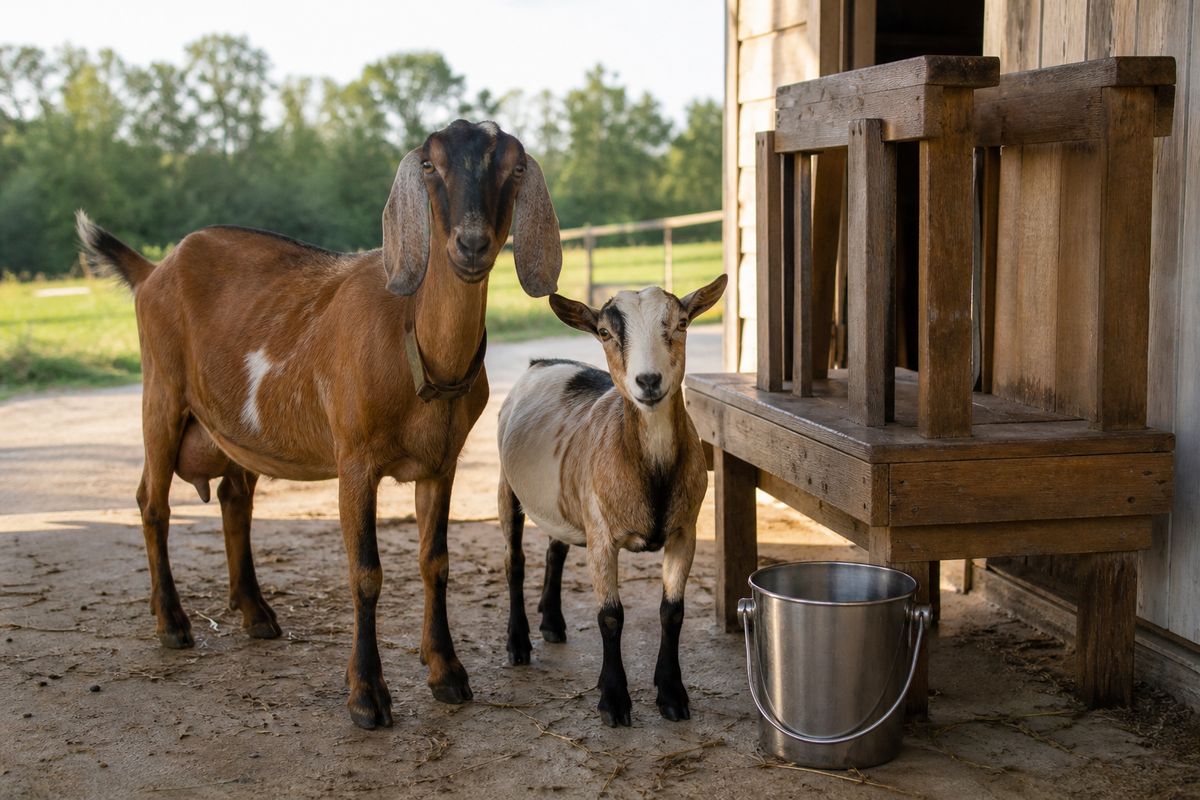
A single well-fed dairy doe can produce anywhere from a half-gallon to two gallons of milk a day depending on breed, more than enough for a family's drinking, cheese, and soap needs from one or two animals in a backyard-sized setup. The tradeoff is that goats are more particular than most beginners expect about fencing, minerals, and parasite management — three areas where a homesteader following cattle or sheep habits by default runs into trouble. Here's what university extension research actually recommends.
Choosing a breed for your goals
Standard dairy breeds all produce more milk than a household typically needs from a single doe; the real choice is butterfat, temperament, and how much space you have:
| Breed | Typical size (doe) | Avg. milk/lactation | Butterfat |
|---|---|---|---|
| Saanen | 135+ lb | ~2,700 lb | 3–3.5% |
| Alpine | 135+ lb | ~2,715 lb | 3.5% |
| Nubian | 135+ lb | ~2,018 lb | 4.6–5% |
| LaMancha | 130+ lb | ~2,298 lb | 3.9–4.2% |
| Toggenburg | 120+ lb | ~2,237 lb | 3.3–3.7% |
| Nigerian Dwarf | ~75 lb | ~795 lb | 6–10% |
If space or a smaller family's needs are the deciding factor, the miniature Nigerian Dwarf produces less total volume but the highest butterfat of any standard dairy breed, which makes it a favorite for home cheesemaking. If you want maximum volume, Saanen and Alpine lead the standard breeds; if butterfat for cheese is the priority at full size, Nubian is the classic choice. Goats are herd animals and become stressed and vocal when kept alone — plan for at least two from the start.
Housing and fencing: goats are escape artists
Extension guidance sizes shelter space by whether goats are on open pasture or in confinement:
- Open housing: 10–15 sq ft of bedded shelter per adult goat, plus about 25 sq ft of outdoor exercise space per goat.
- Confinement housing: a minimum of 25 sq ft of exercise space per animal.
- Kidding pens: a minimum of 4×5 ft of bedded area, set up separately from the main herd.
Fencing is where most new goat owners underestimate the animal. Four-foot-high woven wire topped with a board or a strand of wire is the baseline extension recommendation, and known escape artists may need overhanging wire angled back into the pen (electrified, if necessary) to stop climbing and pushing through weak points. Goats test fences by leaning and rubbing far more than sheep or cattle do, so loose wire or a low spot that would hold other livestock often won't hold a goat.
Feeding: browse first, and the copper trap
Goats are natural browsers — they prefer brush, weeds, and woody plants over the close grazing sheep and cattle do — so pasture that looks "picked over" for a cow can still be good goat forage. Good-quality hay or browse is the foundation of the diet, with grain added only as needed for lactating does, growing kids, or bucks in breeding condition.
The single most important mineral fact for a beginner coming from other livestock: goats need substantially more copper than sheep, and sheep mineral will not meet a goat's needs. Sheep are highly sensitive to copper toxicity, so sheep mineral is deliberately formulated low in copper — feed that same product to goats and they can develop a copper deficiency (anemia, poor hair coat, weight loss, and in severe cases progressive incoordination in young goats). Never keep goats and sheep on the same free-choice mineral, and always buy mineral labeled specifically for goats. Provide loose mineral rather than a block — goats only need about ¼–½ oz of balanced loose mineral a day, and many goats can't get an adequate dose from licking a hard block. Aim for a calcium-to-phosphorus ratio of roughly 2:1 in the overall diet to support bone health and reduce the risk of urinary calculi in males.
Health warning signs to watch for
Internal parasites — especially the blood-feeding barber pole worm — are the most common health threat to backyard goats. Extension programs now recommend checking each individual animal with the FAMACHA eyelid-color scoring system rather than deworming the whole herd on a schedule, since blanket deworming accelerates parasite resistance to the drugs that still work.
| Sign | What it usually means |
|---|---|
| Pale or white inner eyelids | Anemia from internal parasites — FAMACHA score 4–5, needs deworming |
| "Bottle jaw" (swelling under the jaw) | Advanced barber pole worm anemia |
| Rough coat, weight loss, loose feces | General parasite load or nutritional deficiency |
| Sudden bloating of the left side | Bloat — can be an emergency, especially after diet changes |
Rotating pasture so goats don't return to the same ground for about 60 days breaks the parasite lifecycle, and mixed grazing with cattle or horses (which don't share goat parasites) helps further. A stocking density of roughly 8–10 goats per acre is a reasonable extension benchmark for pasture-based parasite management.
Breeding and kidding timeline
Gestation runs 145–155 days, averaging about 150 days. A first-time doe typically has one or two kids; does in later pregnancies commonly have twins, triplets, or even quadruplets.
- ~2 weeks out: the ligaments on either side of the tail head begin to soften and relax.
- 3–4 days out: the udder fills and becomes noticeably enlarged.
- 1–2 days out: teats fill out, the doe becomes restless and paws at the ground, and a thin mucous discharge appears and gradually thickens.
- Final hours: frequent bleating; active labor (from first strong contractions to a kid on the ground) typically runs about 4–5 hours total, with visible pushing usually resolving within an hour once the water sac breaks.
From your first pair of does to a full herd record
Once your herd is settled, tracking breeding dates, kidding outcomes, and milk production is what actually makes goat keeping manageable beyond the first year. The Goat Herd Record Book covers herd inventory, breeding, and health logs, and if dairy goats specifically are the plan, The Homestead Dairy Goat ebook walks through housing, feeding, kidding, milking, and six home cheesemaking and dairy recipes in one guide.
Browse the shop →More Goats, Sheep, Pigs & Cows guides
Free tool: Fence cost calculator →
- Sources:
- New Mexico State University Extension — Housing and Working Facilities for Dairy Goats
- Mississippi State University Extension — Dairy Goat Breeds
- Mississippi State University Extension — Mineral Requirements and Impact on Dairy and Meat Goat Production
- eXtension Goats — Goat Nutrition: Copper
- Alabama Cooperative Extension System — Parasite Control, Dairy Goats and Sheep
- eXtension Goats — Goat Reproduction: Parturition/Kidding
- Merck Veterinary Manual — Pregnancy in Goats