Growing Zucchini & Summer Squash: A Beginner's Guide to Pollination, Blossom Drop & the Squash Vine Borer
Squash plants are famous for producing armloads of flowers and comparatively few actual squash, and for one plant collapsing overnight for no visible reason. Both have straightforward explanations once you know how the flowers work and what to watch for at the base of the stem.
Squash is also the third member of the classic Three Sisters planting — see our companion planting guide for how that system actually works.
Spacing, depth, and timing
University of Maryland Extension, Illinois Extension, and South Dakota State University Extension agree closely on the numbers, with small variations by planting style:
- Hills (2 to 3 plants per hill): 3 to 4 feet within the row, 4 to 6 feet between rows; South Dakota State recommends hills spaced 5 to 6 feet apart on heavier clay soils.
- Single plants in rows: 2 to 3 feet apart within the row, with 3 to 5 feet between rows.
- Direct seeding: sow ½ to 1 inch deep, then thin seedlings to a single vigorous plant per spot (no more than 2 to 3 per hill) once they have 1 to 2 true leaves.
Wait until frost danger has passed and the soil has reached roughly 70°F before planting — squash seed simply sits and rots in cold soil rather than germinating. Illinois Extension notes you can keep planting from early spring into midsummer, and a second sowing around July 1 to 15 is a reliable way to dodge the squash vine borer's main egg-laying window (more on that below) while keeping fresh squash coming later in the season.
Male flowers, female flowers, and why some never become squash
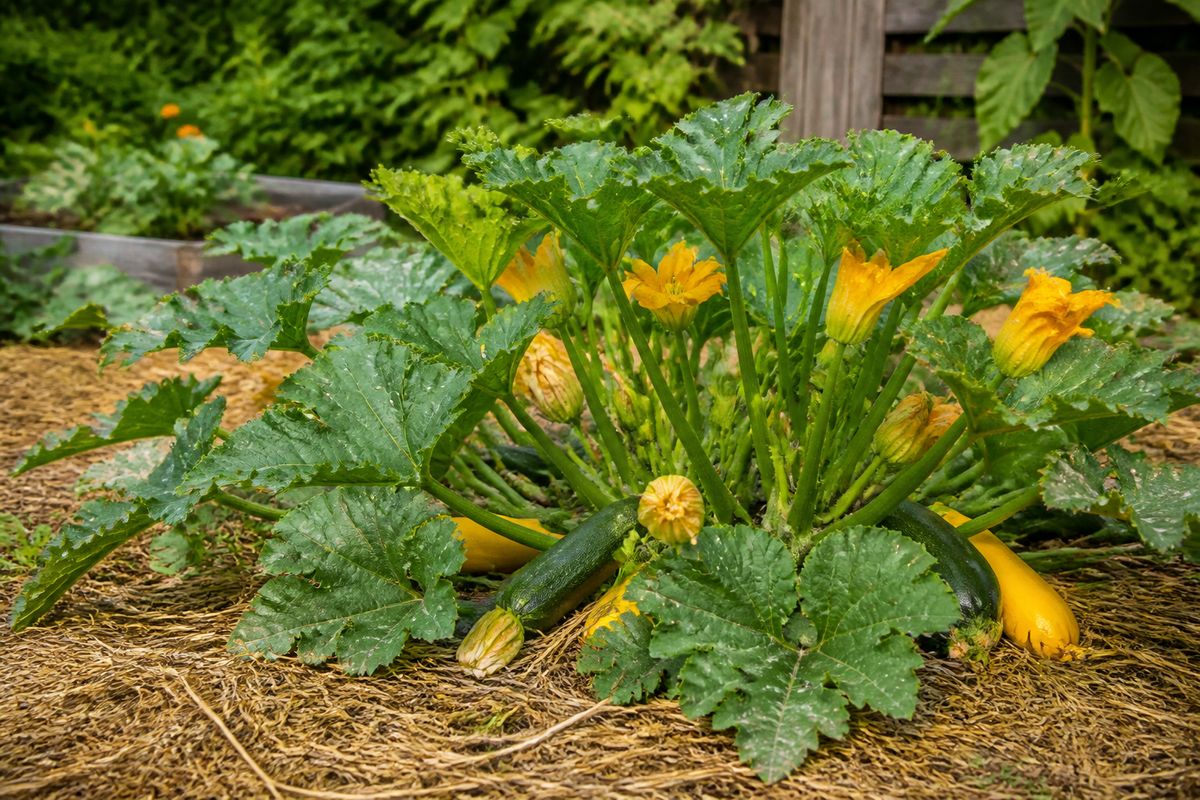
Every squash plant produces two kinds of flowers on the same vine, and only one kind ever turns into a fruit. Illinois Extension describes the tell: male flowers sit on a thin, slender stem, while female flowers have a noticeably thick stem with a small bulge at the base — that bulge is the undeveloped squash itself. Male flowers open first, typically 1 to 2 weeks before the first female flowers, and continue to vastly outnumber them all season. That's normal, not a problem, and it's also why you can harvest a few male blossoms for the kitchen without hurting the plant's yield, as long as you leave enough behind for pollination.
Bees have to carry pollen from a male flower to a female one for fruit to actually set, and University of Maryland Extension points to rainy, cool weather as the most common cause of poor fruit set — bees simply aren't flying, so flowers open, aren't visited, and drop off the vine unfertilized a day or two later. If that's happening in your garden, hand pollination is a reliable fix: pick a freshly opened male flower in the morning, strip the petals back, and dab or brush the pollen-covered center directly onto the center of an open female flower.
If you're growing a parthenocarpic variety (bred to set seedless fruit without any pollination at all), it can stay under row cover or insect netting the entire season; any other variety needs that cover removed once flowering starts so bees can get in.
Fertilizing and watering
Work compost or an all-purpose fertilizer into the soil before planting — Iowa State's sister guidance for cucurbits suggests roughly 1 to 2 lb of 10-10-10 per 100 sq ft where no soil test is available — then side-dress once female flowers begin to appear, the point at which the plant's nutrient demand picks up. Water deeply at the base of the plant, especially once fruit starts forming; South Dakota State puts a number on it, recommending at least 1 inch of water per week from rain or irrigation, with drip irrigation preferred over overhead watering since wet foliage spreads disease more easily.
The squash vine borer: the pest that can kill a healthy-looking plant overnight
This is the pest beginners most need to recognize early, because the first visible symptom — sudden, severe wilting — often looks like the plant is already beyond saving. Illinois Extension lays out the life cycle: the adult is a clear-winged moth that flies during the day and lays single eggs at the base of plants or along leaf stems. Eggs hatch in 7 to 10 days, and the larvae immediately bore into the stem, where they feed for the rest of their larval stage, leaving behind a trail of sawdust-like waste (frass) near the entry hole — the clearest early warning sign, often visible before the plant shows any wilting at all. Once enough stem tissue is damaged, the plant can't move water and nutrients past the injury, and it may wilt within a day or two and eventually die. Damage is worst during extended dry spells in early summer, and borers overwinter as pupae in the soil near where squash grew the year before, emerging again from mid-June into July.
Neither extension office recommends a specific insecticide for borers already inside the stem — by the time frass appears, spraying the surface does nothing for the larva already inside. The non-chemical response both describe is the same: if the main stem is damaged but the vine is still alive, slit the stem lengthwise at the entry point to physically remove the larva, then mound moist soil over the wound and over any stem node that touches the ground — squash roots readily from stem nodes, and a vine that re-roots past the injury can often keep producing even after losing its main stem. Floating row cover over young plants is the preventive option, removed at flowering per the pollination note above, since protecting the plant from borers all season also shuts out the bees it needs.
Squash bugs, bacterial wilt, and powdery mildew
Squash bugs feed on foliage and, in large numbers, inject a toxin that can kill leaves outright — University of Maryland and South Dakota State both list them as a recurring problem without a simple one-step fix; row cover before flowering is the same first line of defense as for vine borers and cucumber beetles. Powdery mildew (a white, dusty coating on leaves) and bacterial wilt are the two diseases both offices flag most often; neither page details treatment beyond the usual cucurbit practices of good airflow, drip rather than overhead watering, and removing visibly diseased foliage promptly.
Harvest
Squash grows fast — Illinois Extension notes fruit is often ready just 4 to 8 days after the flower opens — so check plants daily once they start bearing, and expect to harvest every 1 to 2 days during peak season.
| Type | Harvest size |
|---|---|
| Elongated zucchini/squash | 6 to 8 inches long, about 1½ to 2 inches in diameter |
| Pattypan / scallop types | 3 to 4 inches in diameter |
| Yellow crookneck | 4 to 7 inches long |
A simple test both offices mention: if you can't mark the rind with a thumbnail, the squash has gone past its prime — the skin has hardened and the seeds inside have toughened. Harvest size, not age, is the deciding factor, and removing oversized fruit even when you don't plan to use it keeps the plant setting new squash rather than putting its energy into one giant one. Four healthy plants are enough to supply a family of four through the season, and a well-tended 10-foot row can produce 20 to 40 lb of elongated squash or up to 60 individual fruit over a season.
The short version
Male flowers outnumbering female ones for the first couple of weeks is normal, not a failure. Poor fruit set almost always traces back to bees not visiting during cool, rainy stretches — hand pollination fixes it in the moment. And the squash vine borer is the one pest worth checking for daily once the season's dry spells hit: look for frass at the base of the stem before the plant ever wilts, and know that burying a damaged node in moist soil can save a vine that still has the rest of the season left in it.
Keep these numbers where you'll actually use them
This article covers the reasoning; the Growing Zucchini & Summer Squash Quick-Grow Guide puts the spacing, pollination, and vine-borer steps on a short printable reference for the garden. Growing squash as part of a Three Sisters planting instead? The Three Sisters Garden guide walks through the full corn-bean-squash layout with two bonus recipes, and the Homestead Garden Master Planner covers companion planting, pest identification, and bed layout for the rest of your vegetable beds.
Browse the shop →