Winterizing the Homestead: A Beginner's Checklist for Animals, Pipes & Power
Most winterizing guides tell you to "check on your animals more" without saying what actually changes. The real numbers are more specific than that — and a few of them (like cold stress starting at 50–60°F on a wet, windy day) surprise even people who've wintered animals before.
If you're also putting food by for the season, see our root cellar storage guide — winterizing the barn and winterizing the pantry are two halves of the same fall rush.
Poultry: water and feed needs shift more than people expect
North Carolina State Extension's coop-winterizing guidance gives two numbers worth planning around: chickens' water intake drops to roughly a third of summer levels once temperatures fall to around 40°F (compared with a 90°F day), while feed intake rises by about 1.5 times as birds burn more energy staying warm. A target coop comfort range of 55–75°F supports both egg production and weight.
- Water: check waterers multiple times a day once temperatures drop below freezing — a frozen waterer is a thirsty flock within hours, not days.
- Heat lamps, if used: hang them with wire or chain, never string or twine — a lamp that falls into bedding is one of the most common sources of coop fires, and rodents can chew through string anyway.
- Bedding and ventilation: add extra bedding depth for floor insulation, but don't seal the coop airtight — trapped ammonia from droppings can reach levels that damage birds' eyes and respiratory systems. Seal only the gaps large enough to let light (and a draft) through; keep the rest of the ventilation open.
- Frostbite watch: check combs and wattles daily in freezing weather — look for blackened tips or pale, waxy patches, which are the first visible signs.
Larger livestock: the "1% per degree" rule
For cattle, sheep, and goats, University of Georgia Cooperative Extension puts a real number on something most beginners only sense vaguely: maintenance energy requirements rise by roughly 1% for every degree Fahrenheit the temperature falls below an animal's lower critical temperature — and that can climb to 30% more energy during a genuine cold snap. In practice, that means the hay or feed ration that was enough in October is not enough in January without an increase.
The single most effective fix, per the same guidance, is wind protection — a tree line, a wooded edge, stacked round bales, or a three-sided structure, sited near the feeding area so animals don't have to choose between shelter and food. Pair that with a body-condition check through the season: if animals are visibly losing condition, that's the signal to add energy to the ration before the weather forces the issue.
Water pipes: the simple steps that actually work
Oklahoma State University Extension's frozen-pipe guidance is mostly about moving air and moving water, not exotic fixes:
- Insulate what's exposed — foam pipe wrap or heat tape in unheated basements, attics, garages, and crawl spaces, which is where most residential pipe freezes actually happen.
- Let vulnerable faucets drip — a trickle of moving water is far less likely to freeze solid than standing water, especially on any faucet along an outside wall.
- Open cabinet doors under kitchen and bathroom sinks so household heat can actually reach the pipes behind them.
- Drain and disconnect garden hoses, and shut the interior valve that feeds outdoor hose bibs before the first hard freeze.
- Keep the heat on and in good repair even if you're away — a home with no heat at all is the single biggest risk factor for a burst pipe.
Backup power: the 20-foot rule
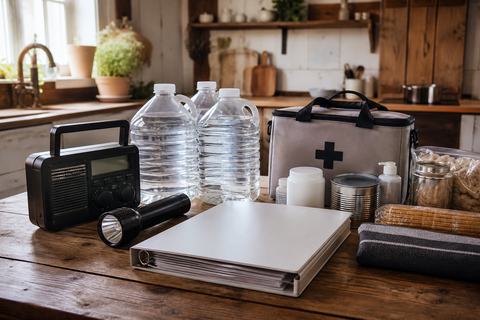
If a winter storm means running a generator, the CDC's carbon monoxide guidance is specific and non-negotiable: keep any gasoline-, propane-, or charcoal-burning generator at least 20 feet from doors, windows, and vents — never in a garage, carport, or basement, even with the door open. Carbon monoxide is odorless and colorless, and it's the actual cause of death in most generator-related winter storm fatalities, not the storm itself.
A full winterizing system, checklist by checklist
This article covers the numbers; the Homestead Winterizing Binder turns them into a 40-page, fill-in-and-check-off system: poultry and small livestock, goats and sheep, garden and orchard put-to-bed, equipment storage, and house/water/power — plus a Winter Prep Calendar from September through March. Storing up food for the season too? See the Homestead Root Cellar & Food Storage Guide, or build out your full emergency plan with the Homestead Emergency & Self-Sufficiency Binder. Winter is also the best time to plan next year's garden and flock: the 2027 Homestead Planner is a dated weekly and monthly planner for garden, animals and farm.
Browse the shop →