Fermenting Vegetables at Home: A Beginner's Guide to Sauerkraut & Pickles
Fermenting is older than canning and needs no special equipment — just vegetables, salt, water, and time. It's also genuinely safe when you follow a tested salt ratio and keep an eye on the crock: a USDA microbiologist quoted by the National Center for Home Food Preservation notes that "the scientific literature has never recorded a case of food poisoning from raw vegetables that have been fermented properly."
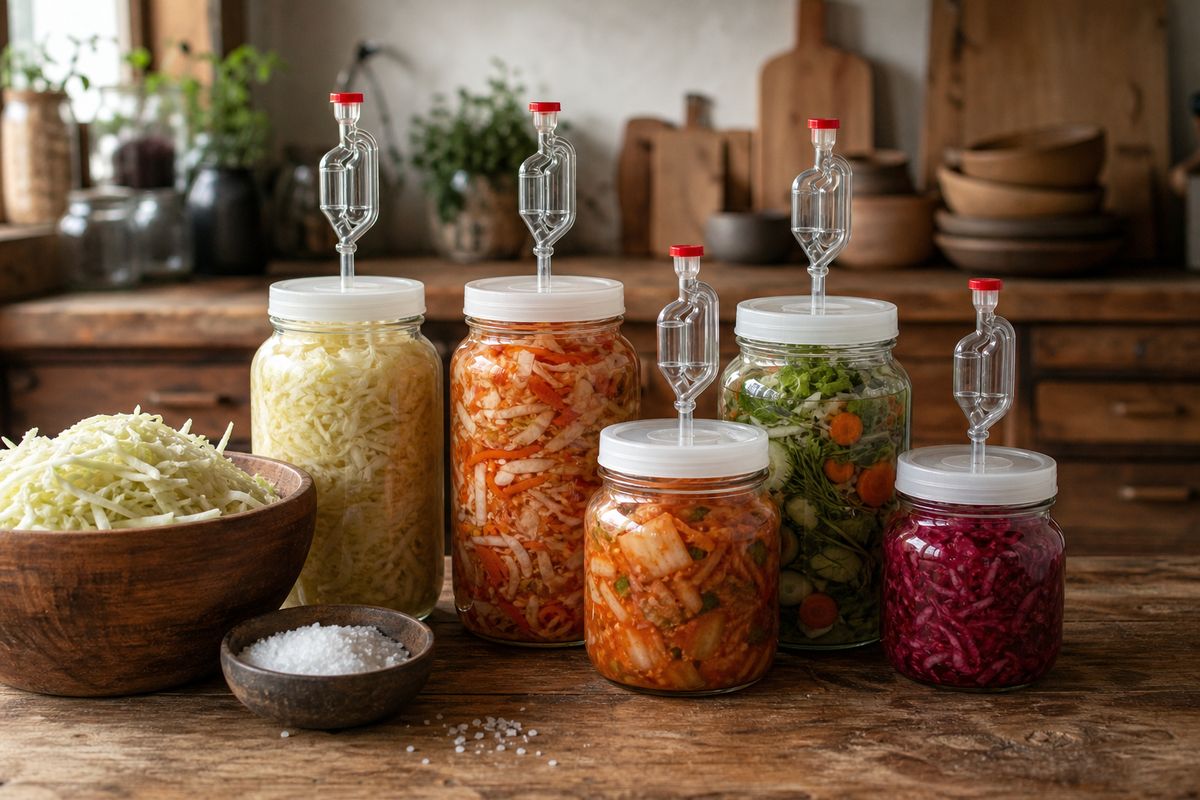
If you'd rather preserve by heat than by fermentation, see our home canning guide — the two methods solve the same problem (keeping food safe without refrigeration) in very different ways.
Why salt is the whole safety system
Fermentation works by starving off spoilage organisms while feeding the lactic acid bacteria that are supposed to take over. Salt does two jobs at once: it draws water out of the vegetable (creating the brine the vegetable then sits in) and it tilts the environment in favor of salt-tolerant lactic acid bacteria over the microbes that would otherwise spoil the batch. As those bacteria work, they drop the brine's pH to 4.6 or below — the same acidity threshold that makes canned high-acid foods shelf-stable — which is what makes a properly fermented vegetable safe. Get the salt ratio and temperature right and the process does the safety work on its own; skip or guess at either one and you're fermenting blind.
Sauerkraut: the benchmark ferment
| Cabbage | Salt | Approximate concentration |
|---|---|---|
| 5 lb shredded cabbage | 3 Tbsp canning/pickling salt | 2.25–2.5% |
| 25 lb shredded cabbage | ¾ cup canning/pickling salt | 2.25–2.5% |
That 2.25–2.5% range isn't arbitrary — Clemson Cooperative Extension notes it specifically favors Leuconostoc, the lactic acid bacteria that get a good ferment started. Pack the salted, shredded cabbage into a container with its rim at least 4–5 in. above the cabbage (it expands as it ferments), then keep it submerged under 1–2 in. of its own brine the whole time — either with a plate weighted down by water-filled jars, or a heavy-duty plastic bag filled with backup brine (1–1½ Tbsp salt per quart of water) laid directly on top.
| Temperature | Time to fully ferment |
|---|---|
| 60–65°F | 5–6 weeks |
| 70–75°F | 3–4 weeks (more acidic, less developed flavor) |
| Below 60°F | May not ferment at all |
| Above 75°F | Kraut can turn soft |
If you're using jar weights rather than a sealed brine bag, check the crock 2–3 times a week and skim off any scum that forms on top — it's a normal byproduct of fermentation, not a sign of failure, as long as you remove it and the vegetable underneath still looks and smells right. Fermentation is done once bubbling stops. From there, fully fermented kraut keeps tightly covered in the refrigerator for several months, or can be canned (hot-pack or raw-pack) for longer shelf storage.
Fermented dill pickles
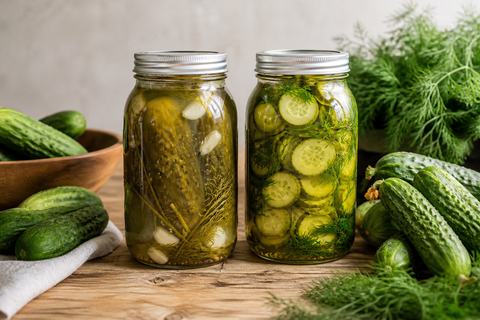
The same brine-and-weight principle applies to whole cucumbers, with its own tested ratio: about ½ cup salt per 8 cups water for the main brine (roughly 1½ Tbsp salt per quart for a backup weight-bag brine). Use small pickling cucumbers (about 4 in.), trim a thin slice off the blossom end, and keep ¼ in. of stem on the other end. A 1-gallon crock holds up to 5 lb of cucumbers; a 5-gallon crock holds up to 25 lb. Keep the cucumbers submerged 1–2 in. under the brine the same way as sauerkraut.
| Temperature | Time to fully ferment |
|---|---|
| 55–56°F | 5–6 weeks |
| 70–75°F | 3–4 weeks |
| Above 80°F | Pickles turn too soft — avoid |
What about kimchi and other vegetables?
Sauerkraut and fermented dill pickles are the two ferments with published, lab-tested salt ratios and timelines behind them — which is why they're the two to start with. Other vegetable ferments (kimchi, fermented carrots, fermented hot sauce, and the like) follow the same core principles — a salt brine strong enough to favor lactic acid bacteria, full submersion, and a cool, stable temperature — but with less formally tested guidance behind the exact ratios. Apply the same vigilance regardless: keep everything submerged, check often for scum, and discard anything that turns slimy or smells wrong rather than risking it.
Every tested ratio and recipe in one place
Want sauerkraut, kimchi, and pickle recipes without hunting down ratios yourself? The Homestead Fermenting Book is a 54-page guide with 22 recipes and no canner required. If you'd rather can than ferment, The Homestead Canning Book covers 25 tested canning recipes, and the Canning Inventory / Pantry & Freezer Log keeps track of every jar and crock by batch and date.
Browse the shop →