
Knowing When to Pick: A Beginner's Guide to Harvest Timing for Canning, Freezing & Drying
Most canning and freezing guides tell you how to process a crop once it's in the kitchen. Almost none of them tell you the two things that decide how good the finished jar actually tastes: whether you picked it at the right stage, and how long it sat on the counter before it hit the heat. Here's both, by crop, from university extension harvest and preservation research.
Already know how to can, freeze or dry — just need to decide which method fits a given crop? Our canning vs. freezing vs. dehydrating guide covers that choice. This article is the step before it: getting the crop off the plant at the right moment in the first place.
The clock that starts the moment you pick
Ohio State University Extension's general preserving guidance is blunt about timing: "for best results, can them within a few hours of harvesting." That's not a suggestion aimed at perfectionists — vegetables keep respiring after they're picked, burning through the sugars and crisp texture that made them worth growing in the first place. Michigan State University Extension and Oregon State University Extension both single out two crops where this matters most:
- Sweet corn: Oregon State's guide states it plainly — "corn is best if it is preserved within a few hours after picking," and "corn loses its sweet flavor rapidly once harvested." Utah State University Extension's sweet corn program gives the sharpest number of any source here: process within 2–3 hours of picking, or refrigerate immediately if you can't get to it that fast.
- English peas: Penn State Extension's guidance is just as direct — can or freeze peas the same day they're picked, full stop. Harvest when pods are bright green and the peas inside are small to medium; once they turn starchy, no amount of good technique in the kitchen fixes what's already happened in the pod.
Berries and leafy greens behave the same way for the same reason — they just don't get the same explicit "hours, not days" warning in most extension literature, so treat "harvest, then process the same day" as the safe default for anything soft, sweet or leafy, and reserve a longer window only for crops extension sources specifically say can wait (most roots, winter squash, and fully dry onions and garlic).
Ripeness signs that actually matter, by crop
The University of Georgia Extension's vegetable harvest guide (Circular 935) gives exact physical signs for dozens of crops — not "when it looks ready," but a specific, checkable test. A sample of the ones that come up most on a mixed homestead:
| Crop | Pick when… |
|---|---|
| Snap beans (bush) | Pods are turgid (firm, full) and seeds are just barely visible through the pod wall |
| Beets | Roots are 2–3 inches across |
| Sweet corn | Kernels are plump, at the "milk stage" — pierce one and a milky liquid, not clear juice, should come out |
| Cucumbers (pickling) | Skin is dark green, before any yellowing starts at the blossom end |
| English peas | Pods are bright green and full; peas inside are small to medium, not swollen |
| Summer squash | A thumbnail easily penetrates the rind |
| Winter squash | A thumbnail can no longer penetrate the rind — the opposite test from summer squash |
| Dry onions | Tops have yellowed and about three-quarters have fallen over on their own |
| Irish potatoes | Tops have begun to die back (see our potato growing & curing guide for the rest of that process) |
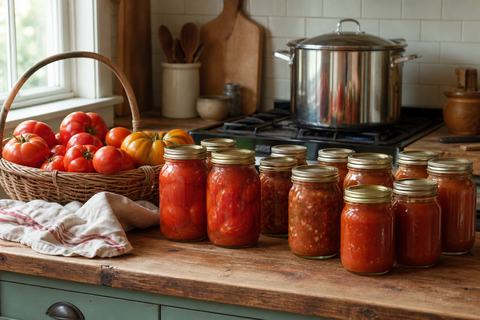
Tomatoes get their own three-stage scale from the same UGA guide, which matters because canning recipes assume a specific stage: mature green (firm, will store 1–2 weeks refrigerated, won't ripen to full flavor off the vine), pink (dime-sized pink patch at the blossom end, ripens to red in about three days at room temperature), and ripe (full red but still firm — use immediately, this is the stage for canning and salsa). Picking at pink and letting it finish on the counter is a legitimate strategy ahead of a frost; picking at mature green and expecting canning-quality flavor is not.
UGA's guide adds one timing habit that applies across almost every crop on this list: harvest early in the day, before the sun has warmed the plant, since that slows the same respiration process that burns through sugar and crispness after picking. Harvesting too late past peak maturity causes its own separate problems — toughness, starch conversion in corn and peas, and produce that's more attractive to pests and disease while it's still on the plant.
A few crops that are the exception, not the rule
Not everything is a race against the clock. UGA's guide notes that sweet potatoes are damaged by soil temperatures below 50°F rather than by waiting too long to dig them, Irish potatoes are damaged by an actual freeze, and winter squash is damaged by frost — all three are telling you to watch the weather, not the hour hand. Soybeans for shelling are the opposite kind of exception: harvest before the pods dry out completely, since dry pods shatter and spill the beans on the ground before you get to them.
The short version
Treat corn and peas as same-day, no-exceptions crops — 2–3 hours for corn if you can manage it, refrigerate immediately if you can't. Treat berries and leafy greens the same way as a safe default. Match the crop to its specific ripeness test rather than a general "it looks ready" guess — a thumbnail test that means one thing for summer squash means the opposite for winter squash. And for anything you're not processing within a few hours, get it into the refrigerator or a cool, shaded spot the moment it's off the plant, not after you've finished harvesting everything else first.
Put this on the wall instead of this page
The Preserving Calendar puts a month-by-month canning, freezing and drying schedule on one printable sheet, and the Canning Times Chart covers exact water-bath and pressure times once the crop is actually in the jar. For the fruit-to-sugar and vinegar ratios that come right after harvest, see the Jam & Pickle Ratios Chart.
Browse the shop →More Food Preservation & Kitchen guides
- Sources:
- University of Georgia Extension — Circular 935, Harvesting and Handling Vegetables for Home Use
- Utah State University Extension — How to Preserve Corn
- Oregon State University Extension Service — SP 50-443, Preserving Corn
- Penn State Extension — Preserving Peas
- Ohio State University Extension — Home Food Preservation Fact Sheet