Harvesting & Extracting Honey: A Beginner's Guide to Knowing When and How
Pull honey too early and it's watery and can ferment in the jar; pull too much, too late, and your bees starve before spring. Here's how to tell a frame is actually ready, the two realistic ways to get the honey out, and how much to leave behind.
If you haven't set up a hive yet, Getting Started with Backyard Beekeeping covers equipment and first-season basics, and the Building a Backyard Beehive guide covers the woodenware itself. This one picks up once a hive actually has surplus honey to take.
How do you know a frame is actually ready?
Oklahoma State University Extension gives a specific threshold, not a guess: harvest a frame once it's at least 80% filled with wax-capped honey. Bees cap a cell only after they've evaporated the nectar down to a stable moisture content, so cappings are the bees telling you the honey underneath is cured.
- Moisture test: a honey refractometer (available online or through a beekeeping supplier) measures the water content directly. OSU Extension's target range is 17–21% moisture. Honey above that range is more likely to ferment in storage.
- No refractometer? Use the shake test. Hold the frame horizontally and give it a firm, gentle shake over the hive. If honey spatters or leaks out of uncapped cells, that frame isn't cured yet — leave it and check again in a week or two.
Choosing a method: crush-and-strain vs. extracting
Both methods are legitimate for a small backyard operation, and which one makes sense mostly comes down to how many hives you're running and whether you want to keep reusing your comb.
| Method | What it needs | Trade-off |
|---|---|---|
| Crush and strain | Two food-grade buckets, a long serrated knife, a potato masher, a honey strainer | Cheapest option, but it destroys the comb — bees have to draw new wax from scratch next season |
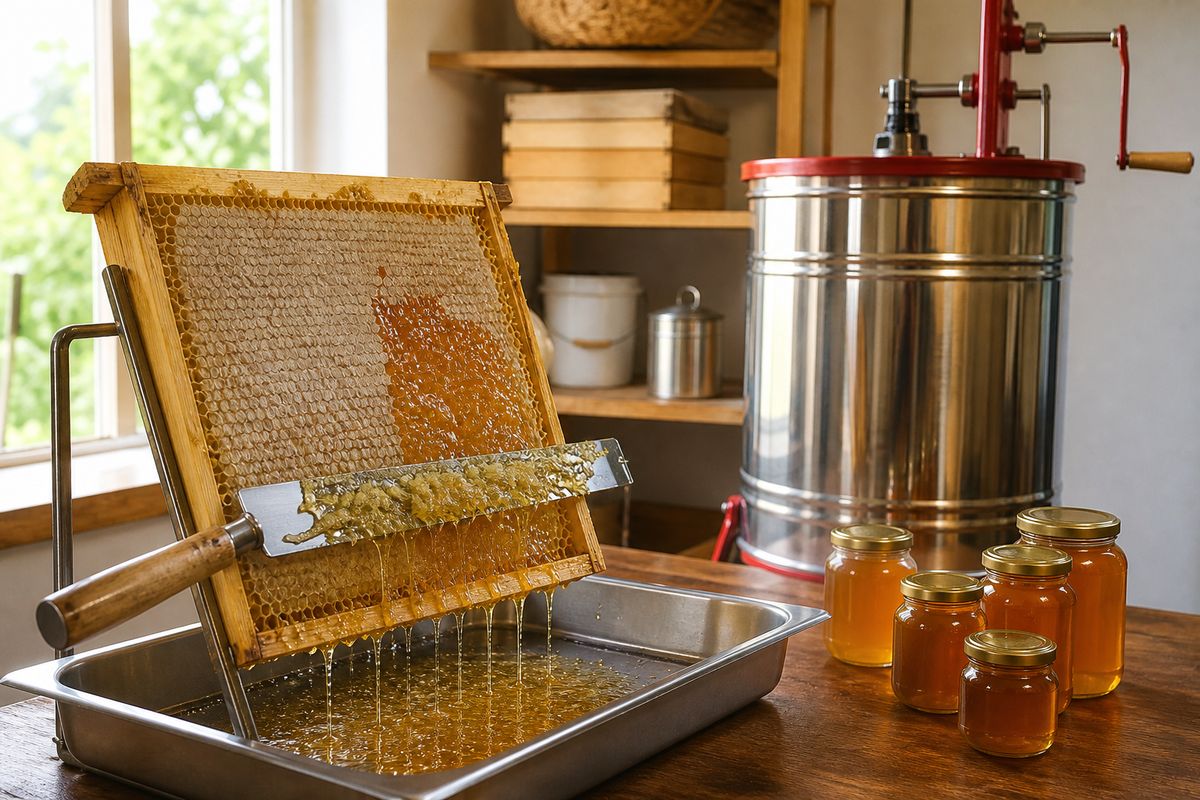
| Extracting | Extractor, uncapping knife, uncapping scratcher/fork, strainer, bottling bucket | More upfront cost (OSU Extension's example setup runs about $395 total), but combs come back empty and get reused, saving the bees the work of rebuilding them |
That comb-rebuilding cost is real, not just theoretical: the University of Arkansas Division of Agriculture Extension's beekeeping short course notes that a worker bee colony has to consume roughly 1 pound of honey to produce just 2 ounces of beeswax. Every frame you crush instead of extract is honey your bees will have to replace with more foraging before they can store it again. If you're only running one or two hives, check whether a local beekeeping club has a shared extractor before buying one outright — UADA Extension notes this is common practice for small-scale beekeepers.
If you're extracting: the actual steps
- Uncap. Use an uncapping knife (a hot-water-dipped serrated knife works fine for a beginner) plus an uncapping fork for the low spots the knife misses, working over an uncapping tank so the wax cappings and dripping honey are both caught.
- Spin. Load uncapped frames into the extractor — either a tangential or radial design — and spin. Centrifugal force throws the honey out of the cells and against the extractor's wall, where it runs down to the bottom.
- Strain. Run the honey through a strainer as it comes out of the extractor's gate to catch stray wax bits and bee parts.
- Settle. Let the strained honey sit in a settling tank for at least 72 hours. Extracting whips a lot of air into the honey, and that settling time lets the air bubbles rise to the top on their own.
- Bottle from the bottom. Draw honey off the bottom of the settling tank, not the top, so what ends up in the jar is clean and free of the foam and debris that collected above it.
Leave enough behind for the bees
How much honey to leave on the hive instead of harvesting depends heavily on your climate. OSU Extension's figures: 60–70 lb per hive in cold climates with a real winter, versus 20–30 lb per hive where winters are mild to nonexistent. That's specifically the amount to leave standing in the hive at harvest time, which is a narrower question than the total stores a colony needs to make it through winter overall — our own beekeeping guide cites a commonly used 80–100 lb total-overwinter-stores figure for comparison. Different sources, slightly different framing of the same underlying question — when the two don't line up exactly, it's worth erring toward leaving more rather than less, especially your first winter with a hive.
After the honey's out
- Let the bees clean sticky equipment. Set used extracting equipment back near (not inside) the hive for a day or two and the bees will lick it clean, recovering honey residue that would otherwise go to waste.
- Store drawn comb carefully. Keep extracted frames in a cool, dry place, protected from wax moths, which will destroy stored comb if given the chance. Comb that survives storage intact saves your bees the energy of rebuilding it next season.
Keep a record of every harvest
The Beekeeping & Apiary Record Book gives you a place to log capping percentage, moisture readings, harvest weight, and what you left behind per hive, year over year. If you're still building out your setup, the Backyard Beehive Build Guide has the full hive-box plans.
Browse the shop →